MCQ
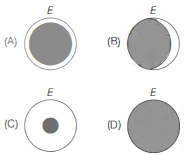
A total solar eclipse is observed from the earth. At the same time an observer on the moon view's the earth. She is most likely to see ( $E$ denotes the earth)
  • A
    $A$
  • B
    $B$
  • $C$
  • D
    $D$

Answer

Correct option: C.
$C$
c
(c)

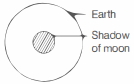
Size of moon is very small compared to that of earth also, moon is much nearer to earth in comparison to sun.

Hence, shadow of moon covers only a small part of earth as shown in the figure given below.
Need a full question paper?

Generate a complete, print-ready paper with questions like this in minutes — across 16+ boards, with answer keys.

Start Generating Free

Similar questions

Following operations can be performed on a capacitor:
X - connect the capacitor to a battery of emf $\in.$
Y - disconnect the battery.
Z - reconnect the battery with polarity reversed.
W - insert a dielectric slab in the capacitor.
  1. In XYZ (perform X, then Y, then Z) the stored electric energy remains unchanged and no thermal energy is developed.
  2. The charge appearing on the capacitor is greater after the action XWY than after the action XYW.
  3. The electric energy stored in the capacitor is greater after the action WXY than after the action XYW.
  4. The electric field in the capacitor after the action XW is the same as that after WX.
Water stands upto a height h behind the vertical wall of a dam. What is the net horizontal force pushing the dam down by the stream, if width of the dam is $\sigma?$ ($\rho$ = density of water).
The potential energy of an object of mass $m$  moving in $xy$  plane in a conservative field is given by $U = ax + by,$  where $x$  and  $y$  are position coordinates of the object. Find magnitude of its acceleration
Speed of electromagnetic waves is the same:
  1. For all wavelengths.
  2. In all media.
  3. For all intensities.
  4. For all frequencies.
Two particles are projected from a tower in opposite directions horizontally with speed $10\,m / s$ each. At $t=1\,s$ match the following two columns.
Column $I$ Column $II$
$(A)$ Relative acceleration between two $(p)$ $0$ SI unit
$(B)$ Relative velocity between two $(q)$ $5$ SI unit
$(C)$ Horizontal distance between two $(r)$ $10$ SI unit
$(D)$ Vertical distance between two $(s)$ $20$ SI unit
The equation of a circle is given by $x^2+y^2=a^2$, where $a$ is the radius. If the equation is modified to change the origin other than $(0,0)$, then find out the correct dimensions of $A$ and $B$ in a new equation: $(x-A t)^2+\left(y-\frac{t}{B}\right)^2=a^2$.The dimensions of $t$ is given as $\left[ T ^{-1}\right]$.
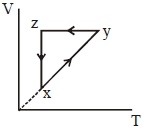
A thermodynamic cycle $xyzx$ is shown on a $V-T$ diagram.

The $P-V$ diagram that best describes this cycle is

(Diagrams are schematic and not to scale)
If the ratio of radii of two liquid drops is 1 : 2 then the ratio of their pressure excess will be
Two masses m1 and m2 are suspended together by a massless spring of spring constant k. When the masses are in equilibrium m1 is removed without disturbing the system, then the angular velocity of oscillation of m2 is:
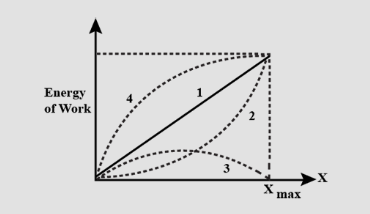
During the displacement, which of the curves shown in the graph best represents the work done on the spring block system by the applied force ?