Question
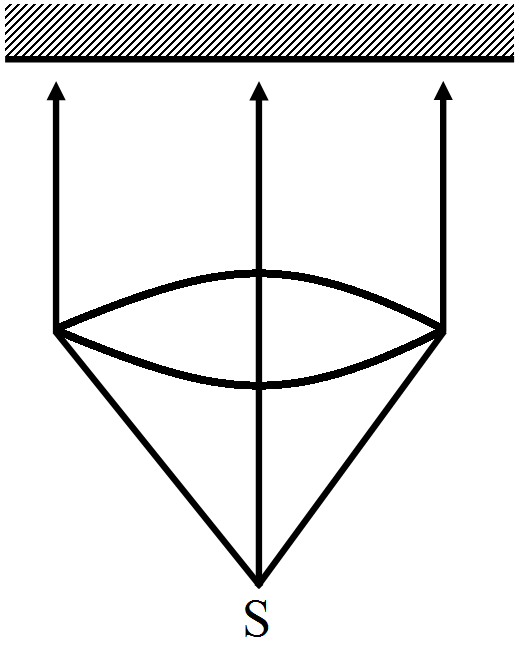
A totally reflecting, small plane mirror placed horizontally faces a parallel beam of light, as shown in the figure. The mass of the mirror is $20g$. Assume that there is no absorption in the lens and that $30\%$ of the light emitted by the source goes through the lens. Find the power of the source needed to support the weight of the mirror. Take $g = 10m/s^2$.
Answer

m = 20g The weight of the mirror is balanced. Thus force exerted by the photons is equal to weight$\text{p}=\frac{\text{h}}{\lambda}$
$\text{E}=\frac{\text{hc}}{\lambda}=\text{pc}$
$\Rightarrow\frac{\text{E}}{\text{t}}=\frac{\text{p}}{\text{t}}\text{c}$
⇒ Rate of change of momentum $=\frac{\text{power}}{\text{C}}$ 30% of light passes through the lens. Thus it exerts force. 70% is reflected.$\therefore$ Force exerted = 2(rate of change of momentum)
$=2\times\frac{\text{power}}{\text{C}}$
$30\%\Big(\frac{2\times\text{power}}{\text{C}}\Big)=\text{mg}$
$\Rightarrow\text{power}=\frac{20\times10^{-3}\times10\times3\times10^{8}\times10}{2\times3}$
$=10\text{W}=100\text{MW.}$

Need a full question paper?

Generate a complete, print-ready paper with questions like this in minutes — across 16+ boards, with answer keys.

Start Generating Free

Similar questions

Draw the graph showing the variation of acceleration due to gravity with
  1. Height above the earth's surface.
  2. Depth below the earth's surface.
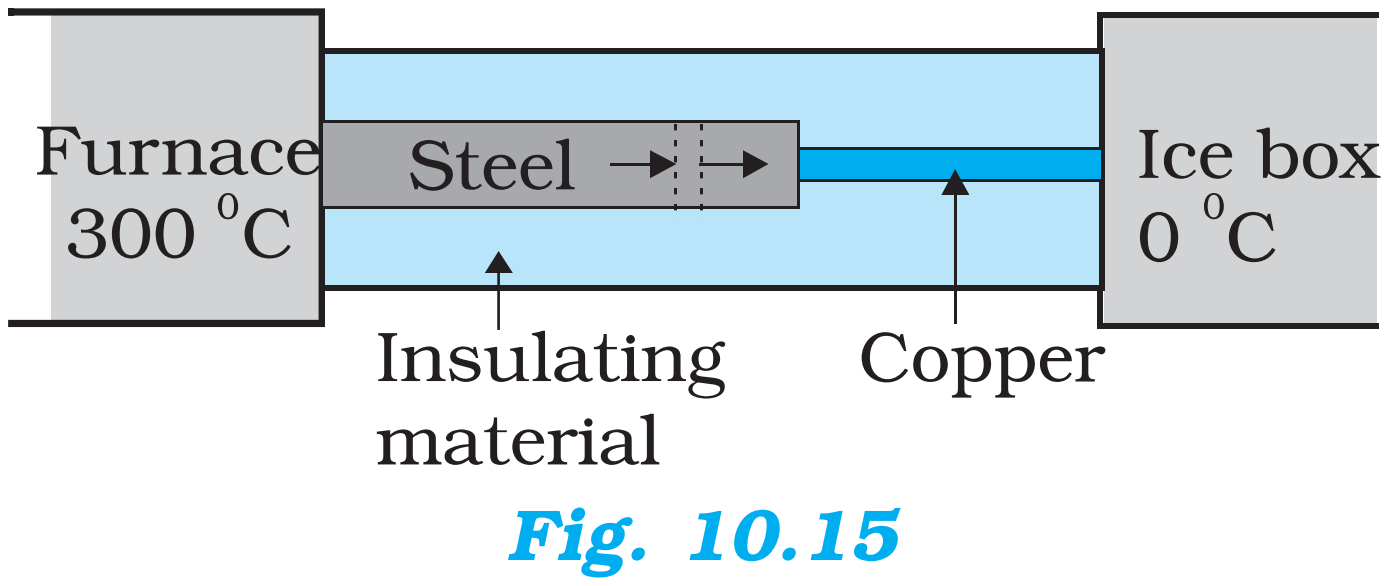
What is the temperature of the steel-copper junction in the steady state of the system shown in Fig. 10.15. Length of the steel rod $=15.0 cm$, length of the copper rod $=10.0 cm$, temperature of the furnace $=300^{\circ} C$, temperature of the other end $=0{ }^{\circ} C$. The area of cross section of the steel rod is twice that of the copper rod. (Thermal conductivity of steel $=50.2 J s ^{-1} m ^{-1} K ^{-1}$; and of copper $\left.=385 J s ^{-1} m ^{-1} K ^{-1}\right)$.
Image
If the acceleration due to gravity on moon is one sixth that on the earth what will be the length and time period of a second's pendulum there? (g = 9.8 ms?)
“Every great physical theory starts as a heresy and ends as a dogma”. Give some examples from the history of science of the validity of this incisive remark.
The number of particles crossing per unit area perpendicular to x-axis in unit time N is given by: $\text{N}=-\text{D}\Big(\frac{\text{n}_2-\text{n}_1}{\text{x}_2-\text{x}_1}\Big)\text{s}$ where $n_1$ and $n_2$ are the number of particles per unit volume at $x_1$ and $x_2​​​​​​​$ respectively. Deduce the dimensional formula for D.
It is said that any charge given to a conductor comes to its surface. Should all the protons come to the surface? Should all the electrons come to the surface? Should all the free electrons come to the surface?
The temperature and the relative humidity are 300K and 20% in a room of volume $50m^3$. The floor is washed with water, 500g of water sticking on the floor. Assuming no communication with the surrounding, find the relative humidity when the floor dries. The changes in temperature and pressure may be neglected. Saturation vapour pressure at 300K = 3.3kPa.
Two parallel rail tracks run north-south. Train A moves north with a speed $54 km / h ^{-1}$ and $\operatorname{train} B$ moves south with a speed of $90 km / h ^{-1}$. What is the:
i. Velocity of $B$ with respect to $A$ ?
ii. Velocity of ground with respect to B?
iii. Velocity of a monkey running on the roof of train $A$ against its motion (with a speed of $10 km^{-1}$ with respect to train A ) as observed by a man standing on the ground?
OR
Obtain any one equation of motion for constant acceleration using method of calculus.
The earth-moon distance is about $60$ earth radius. What will be the diameter of the earth (approximately in degrees) as seen from the moon?
What length of a copper wire of cross-sectional area $0.01mm^2$ will be needed to prepare a resistance of $1\text{k}\Omega?$ Resistivity of copper $=1.7\times10^{-8}\Omega\text{-m}.$