Question
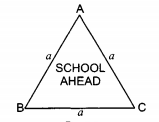
A traffic signal board, indicating SCHOOL AHEAD, is an equilateral triangle with side a. Find the area of the signal board, using Heron’s formula. If its perimeter is 180 cm, what will be the area of the signal board?
Answer


A traffic signal board is an equilateral triangle with side a.
Perimeter of the signal board,
2s = a + a + a 
$\Rightarrow \mathrm{s}=\frac{3}{2} a$
Area of triangle $=\sqrt{s(s-a)(s-b)(s-c)}$
$=\sqrt{\frac{3 a}{2}\left(\frac{3}{2} a-a\right)\left(\frac{3}{2} a-a\right)\left(\frac{3}{2} a-a\right)}$
$=\sqrt{\frac{3 a}{2} \times \frac{a}{2} \times \frac{a}{2} \times \frac{a}{2}}=\sqrt{\frac{3 a^{4}}{16}}=\frac{\sqrt{3}}{4} a^{2}$ sq. units
Now, if perimeter = 180 cm
3a = 180
$\Rightarrow$ a = 60 cm
$\therefore \text { Area of signal board }= \frac{\sqrt{3}}{4} a^{2}=\frac{\sqrt{3}}{4} \times(60)^{2}=900 \sqrt{3} \mathrm{cm}^{2}$
So, area of the signal board is $900 \sqrt{3} \mathrm{cm}^{2}$.

Need a full question paper?

Generate a complete, print-ready paper with questions like this in minutes — across 16+ boards, with answer keys.
Start Generating Free

Similar questions

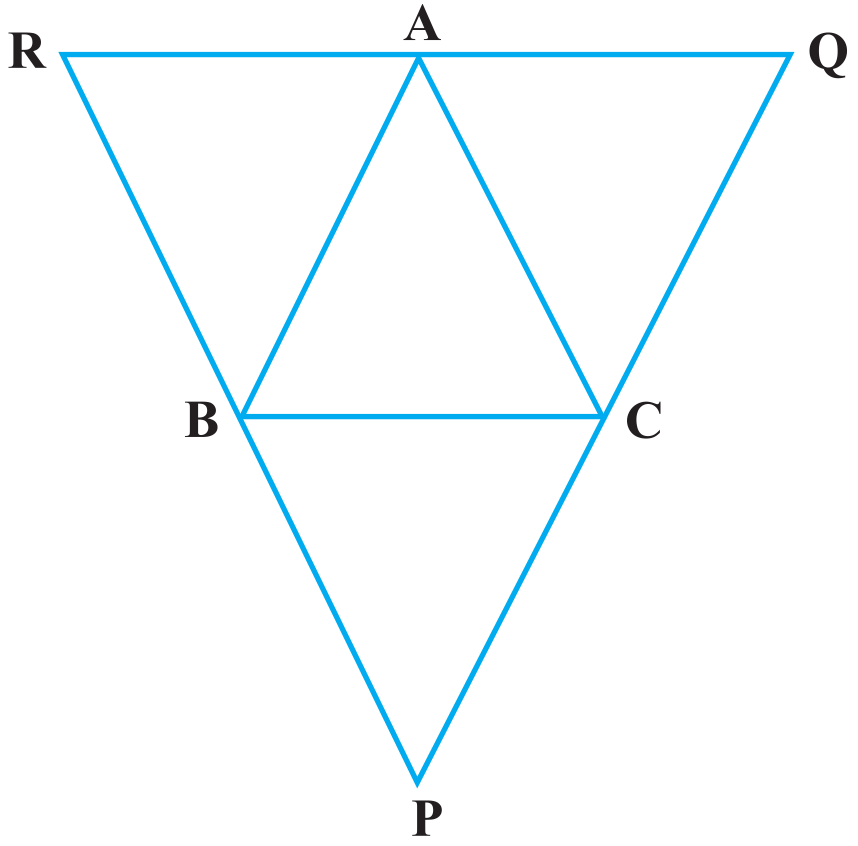
ABC is a triangle and through A, B, C lines are drawn parallel to BC, CA and AB respectively intersecting at P, Q and R. Prove that the perimeter of $\triangle\text{PQR}$ is double the perimeter of $\triangle\text{ABC}.$
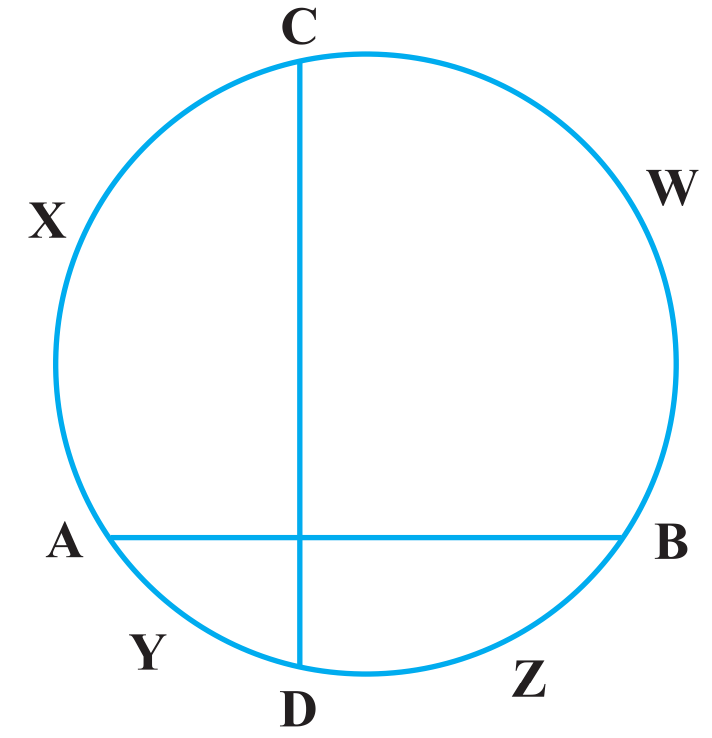
If two chords AB and CD of a circle AYDZBWCX intersect at right angles (see Fig.), prove that arc CXA + arc DZB = arc AYD + arc BWC = semi-circle.

The image of an object placed at a point A before a plane mirror LM is seen at the point B by an observer at D as shown in figure. Prove that the image is as far behind the mirror as the object is in front of the mirror.
P and Q are the point of trisection of the diagonal BD of a parallelogram ABCD. prove that CQ is parallel to AP. prove also that AC bisects PQ.
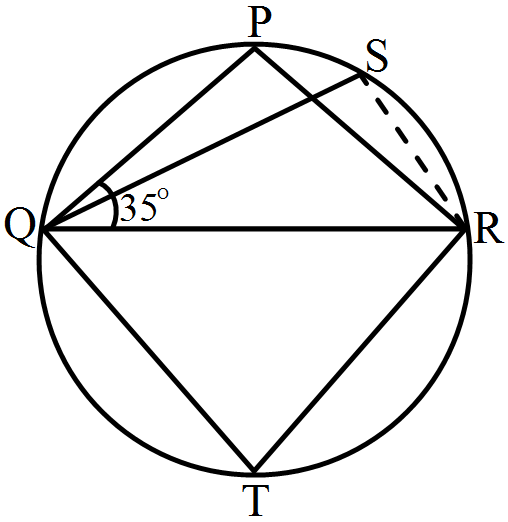
In the given figure, $\triangle\text{PQR}$ is an isosceles triangle with PQ = PR and $\text{m}\angle\text{PQR}=35^\circ.$ Find $\text{m}\angle\text{QSR}$ and $\text{m}\angle\text{QTR}.$

Through A, B and C, lines RQ, PR and QP have been drawn, respectively parallel to sides BC, CA and AB of a $\Delta\text{ABC}$ as shown Show that $\text{BC}=\frac{1}{2}$ QR.

Find the rational roots of the polynomial f(x) = 2x3 + x2 - 7x - 6
If one angle of a triangle is equal to the sum of the other two, show that the triangle is a right angle triangle.
The surface area of a sphere of radius 5cm is five times the area of the curved surface of a cone of radius 4cm. Find the height of the cone.
Points A(5, 3), B(-2, 3) and D(5, -4) are three vertices of a square ABCD. Plot these points on a graph paper and hence find the coordinates of the vertex C.