MCQ
A train is moving at a constant speed $V$. When its driver observes another train in front of him on the same track and moving in the same direction with constant speed $u$. If the distance between the trains be $x$, then what should be the minimum retardation of the train so as to avoid collision?
  • A
    $(V + u)^2\,/x$
  • B
    $(V -u)^2\,/x$
  • C
    $(V + u)^2\,/2x$
  • $(V -u)^2\,/2x$

Answer

Correct option: D.
$(V -u)^2\,/2x$
d
Here relative velocity of the train $w.r.t.$ other

$\operatorname{train}=V-u$

Hence,

$0-(\mathrm{V}-\mathrm{u})^{2}=2 \mathrm{ax}$ or $\mathrm{a}=-\frac{(\mathrm{V}-\mathrm{u})^{2}}{2 \mathrm{x}}$

Minimum retardation $=\frac{(\mathrm{V}-\mathrm{u})^{2}}{2 \mathrm{x}}$

Need a full question paper?

Generate a complete, print-ready paper with questions like this in minutes — across 16+ boards, with answer keys.

Start Generating Free

Similar questions

A thin circular disc of mass $M$ and radius $R$ is rotating in a horizontal plane about an axis passing through its centre and perpendicular to its plane with angular velocity $\omega$. If another disc of same dimensions but of mass $\mathrm{M} / 2$ is placed gently on the first disc co-axially, then the new angular velocity of the system is :
The moment of inertia of a solid sphere, about an axis parallel to its diameter and at a distance of $x$ from it, is $I(x)$. Which one of the graphs represents the variation of $I(x)$ with $x$ correctly?
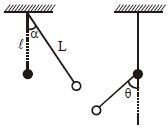
A simple pendulum consisting of a mass $M$ attached to a string of length $L$ is released from rest at an angle $\alpha$. $A$ pin is located at a distance $l$ below the pivot point. When the pendulum swings down, the string hits the pin as shown in the figure. The maximum angle $\theta$ which string makes with the vertical after hitting the pin is :-
Five gas molecules chosen at random are found to have speeds of $500,600,700,800$ and $900 m / s$. Then which of the following statements is correct?
The wavefronts of light coming from a distant source of unknown shape are nearly:
  1. Plane.
  2. Elliptical.
  3. Cylindrical.
  4. Spherical.
An engine is attached to a wagon through a shock absorber of length $1.5\, {m}$. The system with a total mass of $40,000\, {kg}$ is moving with a speed of $72\, {kmh}^{-1}$ when the brakes are applied to bring it to rest. In the process of the system being brought to rest, the spring of the shock absorber gets compressed by $1.0\, {m}$. If $90\, \%$ of energy of the wagon is lost due to friction, the spring constant is $....\, \times 10^{5}\, {N} / {m}$
What will be the acceleration due to gravity at height $h$ if $h >> R$. Where $R$ is radius of earth and $g$ is acceleration due to gravity on the surface of earth
A wave is represented by $x=4 \cos \left(8 t-\frac{y}{2}\right)$, where $x$ and $y$ are in metre and $t$ in second. The frequency of the wave $\left(\right.$ in $^{-1}$ ) is .........
A loaded spring gun of mass M fires a 'shot' of mass m with a velocity at an angle of elevation $\theta.$ The gun is initially at rest on a horizontal frictionless surface. After firing, the centre of mass of the gun-shot system.
If a satellite orbits as close to the earth's surface as possible,