MCQ
A train is moving with velocity $20\, m/sec$. on this dust is falling at the rate of $50 \,kg/minute$. The extra force required to move this train with constant velocity will be ....... $N$
  • $16.66$
  • B
    $1000$
  • C
    $166.6$
  • D
    $1200$

Answer

Correct option: A.
$16.66$
a
(a)$F = u\;\left( {\frac{{dm}}{{dt}}} \right) = 20 \times \frac{{50}}{{60}} = 16.66\,N$

Need a full question paper?

Generate a complete, print-ready paper with questions like this in minutes — across 16+ boards, with answer keys.
Start Generating Free

Similar questions

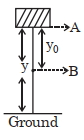
In the given figure, the block of mass $m$ is dropped from the point ' $A$ '. The expression for kinetic energy of block when it reaches point ' $B$ ' is ................
A string of length $1 \mathrm{~m}$ and mass $2 \times 10^{-5} \mathrm{~kg}$ is under tension $\mathrm{T}$. when the string vibrates, two successive harmonics are found to occur at frequencies $750 \mathrm{~Hz}$ and $1000 \mathrm{~Hz}$. The value of tension $\mathrm{T}$ is. . . . . . .Newton.
A ring takes time ${t_1}$ in slipping down an inclined plane of length $L$ and takes time ${t_2}$ in rolling down the same plane. The ratio $\frac{{{t_1}}}{{{t_2}}}$ is
What is constant in S.H.M.
A clock has $75 \mathrm{~cm}, 60 \mathrm{~cm}$ long second hand and minute hand respectively. In $30$ minutes duration the tip of second hand will travel $x$ distance more than the tip of minute hand. The value of $x$ in meter is nearly (Take $\pi=3.14$ ) :
Two parallel, long wires carry currents $i_1$ and $i_2$ with $i_1 > i_2$. When the currents are in the same direction, the magnetic field at a point midway between the wires is $10 \mu\text{T}.$ If the direction of $i_2$ is reversed, the field becomes $30 \mu\text{T}.$ The ratio $\frac{\text{i}_1}{\text{i}_2}$ is:
A piece of copper having an internal cavity weights $264\, g$ in air and $221\, g$ in water. Find volume (in $cc$) of cavity. Density of $Cu = 8.8\, g/cc$
The angles which a vector $\hat i + \hat j + \sqrt 2 \,\hat k$ makes with $X, Y$ and $Z$ axes respectively are
The result after adding $3.8 \times 10^{-6}$ with $4.2 \times 10^{-5}$ with due regard to  significant figures is-
A particle executing $SHM$ of amplitude $4\,cm$ and $T = 4s.$ The time taken by it to move from $+2\,cm$ to $+2\sqrt 3\,cm$ is