Question
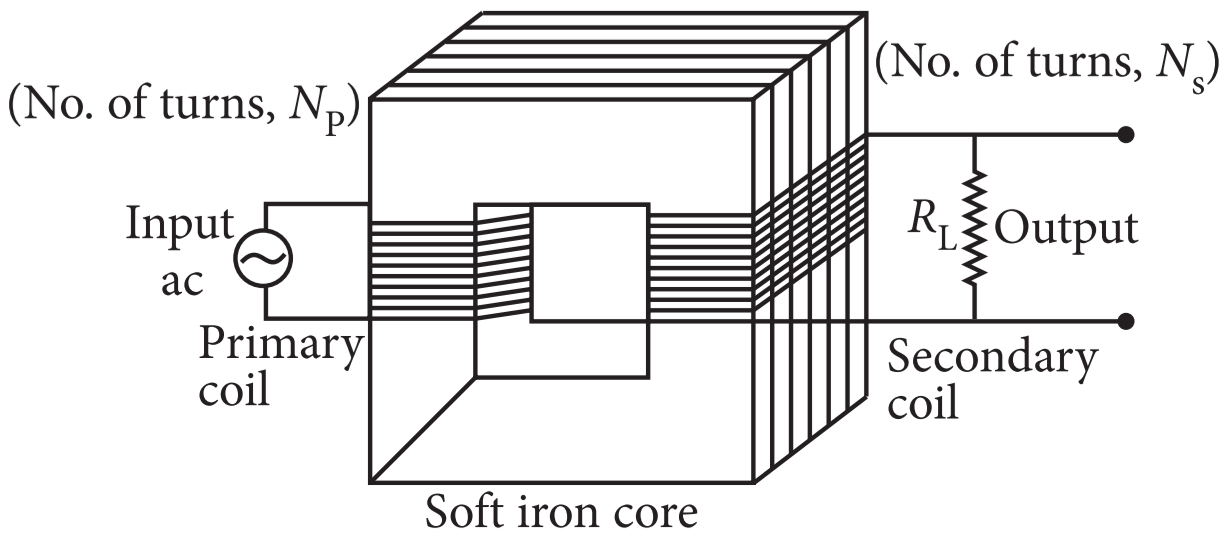
✓
Answer
- (c) Power
Explanation:
In an ideal transformer, there is no power loss. The efficiency of an ideal transformer is $\eta=1$ (i.e 100%) i.e. input power = output power.
- (d) Obtain desired ac voltage and current.
Explanation:
Transformer is used to obtain desired ac voltage and current.
- (c) ac 110V
Explanation:
For a transformer, $\frac{\text{V}_\text{S}}{\text{V}_\text{p}}=\frac{\text{n}_\text{S}}{\text{n}_\text{p}}$
Where N denotes number of turns and V = voltage.
$\therefore{\text{V}_\text{S}}={\text{ac}\ 110}{\text{V}}$
- (a) Current through its secondary is about four times that of the current through its primary.
Explanation:
In a transformer the primary and secondary currents are related by,
$\text{I}_\text{S}=\Big(\frac{\text{N}_\text{S}}{\text{N}_\text{P}}\Big)\text{I}_\text{P}$
And the Voltage are related by,
$\text{V}_\text{S}=\Big(\frac{\text{N}_\text{P}}{\text{N}_\text{S}}\Big)\text{V}_\text{P}$
where subscripts p and s refer to the primary and secondary of the transformer.
Here, $\text{V}_\text{P}=\text{V},\frac{\text{N}_\text{P}}{\text{N}_\text{S}}=4\ \therefore\text{I}_\text{P}=4\text{I}_\text{P}$
and, $\text{V}_\text{S}=\Big(\frac{1}{4}\Big)\text{V}=\frac{\text{V}}{4}$
- (c) 90%
Explanation:
The efficiency of the transformer is:
$\eta=\frac{\text{output power}(\text{p}_\text{out})}{\text{intput power}(\text{p}_\text{in})}\times100$
Here, Pout = 100W, Pin = (220V)(0.5A) = 110W
$\therefore\eta=\frac{100\text{W}}{110\text{W}}\times100=90\%$
Need a full question paper?
Generate a complete, print-ready paper with questions like this in minutes — across 16+ boards, with answer keys.
Explore more
Similar questions
A bar magnet whose area of cross-section is $0.25 cm^2$ is kept in a magnetising field of intensity of $5000 A / m$. If magnitude of magnetic flux passing through the bar is $2.5 \times 10^{-5}$ weber, then calculate :(a) Magnetic induction (b) Magnetic susceptibility (c) Intensity of magnetisation.
→A magnetic dipole of magnetic moment 0.72A-m2 is placed horizontally with the north pole pointing towards bsouth. Find the position of the neutral point if the horizontal component of the earth's magnetic field is $18\mu\text{T.}$
→Two point charges $+3.2 \times 10^{-19}$ Coulomb and $-3.2 \times 10^{-19}$ Coulomb are kept at a distance of 2.4 $\times 10^{-10}$ meters from each other. This dipole is placed at an angle of $30^{\circ}$ to the field direction in a uniform field of intensity of $3 \times 10^4$ Newton/Coulomb. Find the value of the moment of the couple acting on it. What will be the maximum value of this torque?
→A container contains water upto a height of 20cm and there is a point source at the centre of the bottom of the container. A rubber ring of radius r floats centrally on the water. The ceiling of the room is 2.0m above the water surface.
→- Find the radius of the shadow of the ring formed on the ceiling if r = 15cm.
- Find the maximum value of r for which the shadow of the ring is formed on the ceiling. Refractive index of water $\frac{4}{3}.$
The electrostatic force on a small sphere of charge $0.4 \mu C$ due to another small sphere of charge $-0.8 \mu C$ in air is 0.2 N (a) What is the distance between the two spheres? (b) What is the force on the second sphere due to the first?
→ln Young's double slit experiment, the width of the central bright fringe is equal to the distance between the first dark fringes on the two sides of the central bright fringe.
ln given figure below a screen is placed normal to the tine joining the two point coherent source S1 and S2. The interference pattern consists of concentric circles.
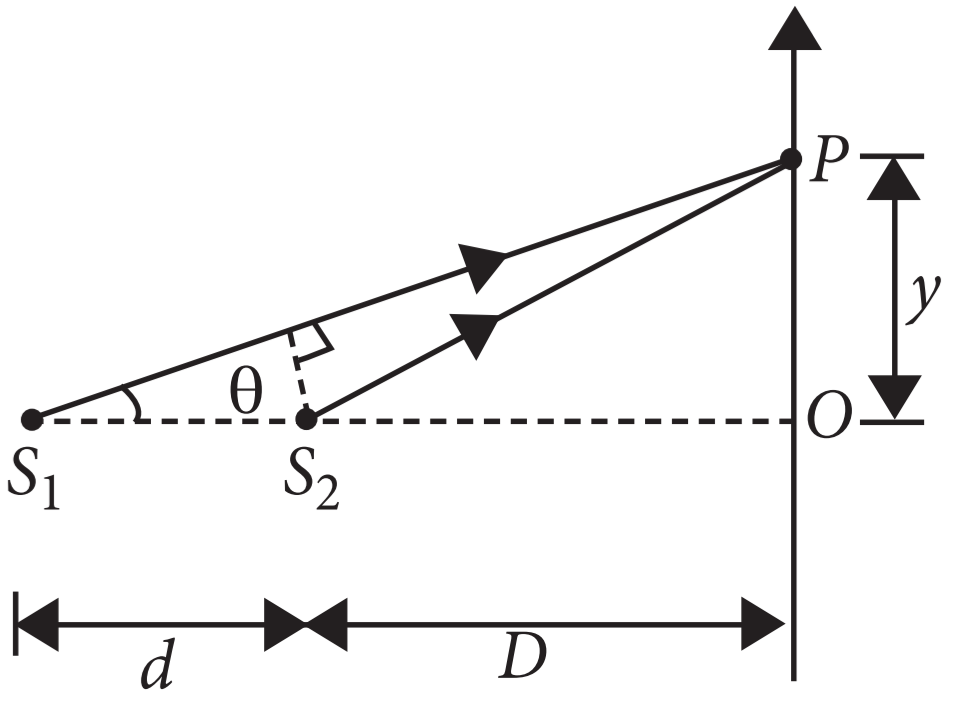
→ln given figure below a screen is placed normal to the tine joining the two point coherent source S1 and S2. The interference pattern consists of concentric circles.
- The optical path difference at P is:
- $\text{d}\Big[1+\frac{\text{y}^2}{2\text{D}}\Big]$
- $\text{d}\Big[1+\frac{2\text{D}}{\text{y}^2}\Big]$
- $\text{d}\Big[1-\frac{\text{y}^2}{2\text{D}^2}\Big]$
- $\text{d}\Big[2\text{D}-\frac{1}{\text{y}^2}\Big]$
- Find the radius of the nth bright fringe.
- $\text{D}\sqrt{1\Big(1-\frac{\text{n}\lambda}{\text{d}}\Big)}$
- $\text{D}\sqrt{2\Big(1-\frac{\text{n}\lambda}{\text{d}}\Big)}$
- $2\text{D}\sqrt{2\Big(1-\frac{\text{n}\lambda}{\text{d}}\Big)}$
- $\text{D}\sqrt{2\Big(1-\frac{\text{n}\lambda}{2\text{d}}\Big)}$
- If $\text{d}=0.5\text{mm}.\lambda=5000\mathring{\text{A}}$ and D = 100cm, find the value of n for the closest second bright fringe.
- 888
- 830
- 914
- 998
- The coherence of two light sources means that the light waves emitted have.
- Same frequency.
- Same intensity.
- Constant phase difference.
- Same velocity.
- The phenomenon of interference is shown by:
- Longitudinal mechanical waves only.
- Transverse mechanical waves only.
- Electromagnetic waves only.
- All of these.
A car driver going at some speed v suddenly finds a wide wall at a distance r. Should he apply brakes or turn the car in a circle of radius r to avoid hitting the wall?
Coulomb's law states that the electrostatic force of attraction or repulsion acting between two stationary point charges is given by
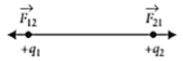
where F denotes the force between two charges $q _1$ and $q _2$ separated by a distance r in free space, $\varepsilon_0$ is a constant known as the permittivity of free space. Free space is a vacuum and may be taken to be air practically. If free space is replaced by a medium, then $\varepsilon_0$ is replaced by $\left(\varepsilon_0 k\right)$ or $\left(\varepsilon_0 \varepsilon_r\right)$ where k is known as dielectric constant or relative permittivity.
(i) In coulomb's law, $F =k \frac{q_1 q_2}{r^2}$, then on which of the following factors does the proportionality constant k depends?
(a) Nature of the medium between the two charges
(b) Distance between the two charges
(c) Electrostatic force acting between the two charges
(d) Magnitude of the two charges
(ii) Dimensional formula for the permittivity constant $\varepsilon_0$ of free space is
(a) $\left[ M ^{-1} L^3 T^2 A^2\right]$
(b) $\left[ ML ^{-3} T^4 A^2\right]$
(c) $\left[ M ^{-1} L^{-3} T^4 A^2\right]$
(d) $\left[ ML ^{-3} T^4 A^{-2}\right]$
(iii) The force of repulsion between two charges of 1 C each, kept 1m apart in vaccum is
(a) $\frac{1}{9 \times 10^9} N$
(b) $\frac{1}{9 \times 10^{12}} N$
(c) $9 \times 10^7 N$
(d) $9 \times 10^9 N$
(iv) Two identical charges repel each other with a force equal to 10 mgwt when they are 0.6 m apart in air. ( $g =$ $10 m s ^{-2}$ ). The value of each charge is
(a) 2 mC
(b) $2 \times 10^{-7} mC$
(c) $2 \mu C$
(d) 2 nC
OR
Coulomb's law for the force between electric charges most closely resembles with
(a) law of conservation of energy
(b) Newton's 2nd law of motion
(c) law of conservation of charge .
(d) Newton's law of gravitation
→where F denotes the force between two charges $q _1$ and $q _2$ separated by a distance r in free space, $\varepsilon_0$ is a constant known as the permittivity of free space. Free space is a vacuum and may be taken to be air practically. If free space is replaced by a medium, then $\varepsilon_0$ is replaced by $\left(\varepsilon_0 k\right)$ or $\left(\varepsilon_0 \varepsilon_r\right)$ where k is known as dielectric constant or relative permittivity.
(i) In coulomb's law, $F =k \frac{q_1 q_2}{r^2}$, then on which of the following factors does the proportionality constant k depends?
(a) Nature of the medium between the two charges
(b) Distance between the two charges
(c) Electrostatic force acting between the two charges
(d) Magnitude of the two charges
(ii) Dimensional formula for the permittivity constant $\varepsilon_0$ of free space is
(a) $\left[ M ^{-1} L^3 T^2 A^2\right]$
(b) $\left[ ML ^{-3} T^4 A^2\right]$
(c) $\left[ M ^{-1} L^{-3} T^4 A^2\right]$
(d) $\left[ ML ^{-3} T^4 A^{-2}\right]$
(iii) The force of repulsion between two charges of 1 C each, kept 1m apart in vaccum is
(a) $\frac{1}{9 \times 10^9} N$
(b) $\frac{1}{9 \times 10^{12}} N$
(c) $9 \times 10^7 N$
(d) $9 \times 10^9 N$
(iv) Two identical charges repel each other with a force equal to 10 mgwt when they are 0.6 m apart in air. ( $g =$ $10 m s ^{-2}$ ). The value of each charge is
(a) 2 mC
(b) $2 \times 10^{-7} mC$
(c) $2 \mu C$
(d) 2 nC
OR
Coulomb's law for the force between electric charges most closely resembles with
(a) law of conservation of energy
(b) Newton's 2nd law of motion
(c) law of conservation of charge .
(d) Newton's law of gravitation
Gauss's law and Coulomb's law, although expressed in different forms, are equivalent ways of describing the relation between charge and electric field in static conditions. Gauss's law is $\in_0\phi=\text{q}_{\text{end},}$ when $\text{q}_{\text{encl}}$ is the net charge inside an imaginary closed surface called Gaussian surface. $\phi=\oint\vec{\text{E}}\cdot\text{d}\vec{\text{A}}$ gives the electric flux through the Gaussian surface. The two equations hold only when the net charge is in vacuum or air.
→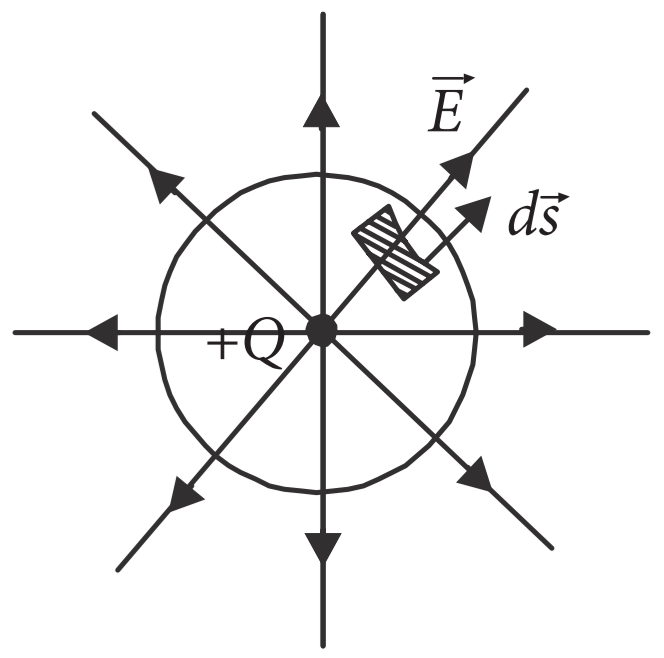
- If there is only one type of charge in the universe, then ($\vec{\text{E}}\rightarrow$ Electric field, $\text{d}\vec{\text{s}}\rightarrow$ Area vector).
- $\oint\vec{\text{E}}\cdot\text{d}\vec{\text{s}}\not=0$ on any surface.
- $\oint\vec{\text{E}}\cdot\text{d}\vec{\text{s}}$ could not be defined.
- $\oint\vec{\text{E}}\cdot\text{d}\vec{\text{s}}=\infty$ if charge is inside.
- $\oint\vec{\text{E}}\cdot\text{d}\vec{\text{s}}=0$ if charge is outside, $\oint\vec{\text{E}}\cdot\text{d}\vec{\text{s}}=\frac{\text{q}}{\in_0}$ if charge is inside.
- What is the nature of Gaussian surface involved in Gauss law of electrostatic?
- Magnetic.
- Scalar.
- Vector.
- Electrical.
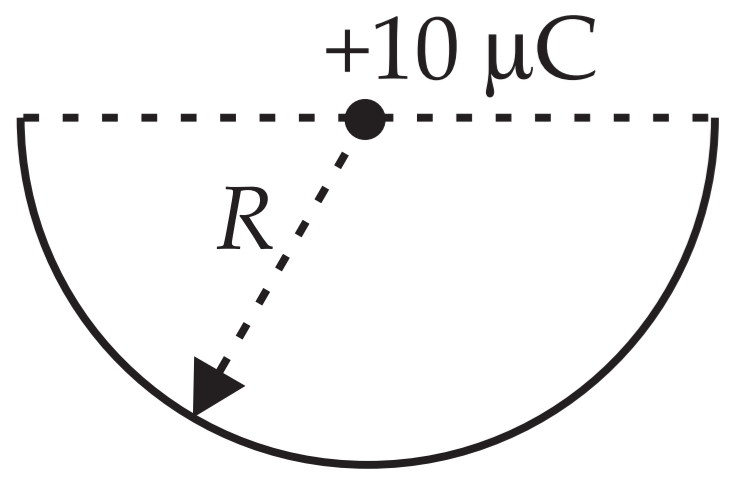
- A charge $10\mu\text{C}$ is placed at the centre of a hemisphere of radius R = 10cm as shown. The electric flux through the hemisphere (in MKS units) is:
- 20 × 105
- 10 × 105
- 6 × 10⁵
- 2 × 10⁵
- The electric flux through a closed surface area S enclosing charge Q is $\phi$. If the surface area is doubled, then the flux is:
- $2\phi$
- $\frac{\phi}{2}$
- $\frac{\phi}{4}$
- $\phi$
- A Gaussian surface encloses a dipole. The electric flux through this surface is:
- $\frac{\text{q}}{\in_0}$
- $\frac{\text{2q}}{\in_0}$
- $\frac{\text{q}}{2\in_0}$
- $\text{Zero}$
A long bar magnet has a pole strength of 10A-m. Find the magnetic field at a point on the axis of the magnet at a distance of 5cm from the north pole of the magnet.