Question
A transistor oscillator is
$(i)$ an amplifier with positive feedback $(ii)$ an amplifier with reduced gain $(iii)$ the one in which $dc$ supply energy is converted into an output energy. Then
Answer

Get the step-by-step solution for this question inside the Vidyadip app.

Get the answer in the app

Need a full question paper?

Generate a complete, print-ready paper with questions like this in minutes — across 16+ boards, with answer keys.

Start Generating Free

Similar questions

A photon of energy $E$ ejects a photoelectron from a metal surface whose work function is $W_0.$ If this electron enters into a uniform magnetic field of induction $B$ in a direction perpendicular to the field and describes a circular path of radius $r,$ then the radius $r,$ is given by (in the usual notation)
Assertion : The formula connecting $u,\,v$ and $f$ for a spherical mirror is valid only for mirrors whose sizes are very small compared to their radii of curvature.

Reason : Laws of reflection are strictly valid for plane surfaces, but not for large spherical surface.

An infinitely long rod lies along the axis of a concave mirror of focal length $f$. The near end of the rod is at a distance $u >f$ from the mirror. Its image will have a length 
A thin wire of length $l$ is carrying a constant current. The wire is bent to form a circular coil. If radius of the coil, thus formed, is equal to $R$ and number of turns in it is equal to $n$, then which of the following graphs represent $(s)$ variation of magnetic field induction $(b)$ at centre of the coil
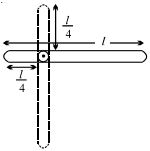
For the pivoted slender rod of length $l$ as shown in figure, the angular velocity as the bar reaches the vertical position after being released in the horizontal position is
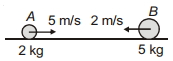
Velocity of the ball $A$ after collision with the ball $B$ as shown in the figure is ............. $m / s$ (Assume perfectly inelastic and headon collision)
A force of $(3\hat i + 4\hat j)\, N$ acts on a body and displaces it by $(3\hat i + 4\hat j)\,m$ . The work done by the force is ............. $\mathrm{J}$
An ideal battery of $4\, V$ and resistance $R$ are connected in series in the primary circuit of a potentiometer of length $1\, m$ and resistance $5\,\Omega $ . The value of $R$, to give a difference of $5\, mV$ across $10\, cm$ of potentiometer wire, is: ................ $\Omega$
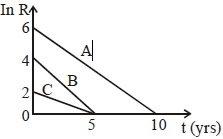
Activities of three radioactive substances $A , B$ and $C$ are represented by the curves $A, B$ and $C,$ in the figure. Then their half-lives $T _{\frac{1}{2}}( A ): T _{\frac{1}{2}}( B ): T _{\frac{1}{2}}( C )$ are in the ratio
The acceleration of a body due to the attraction of the earth (radius $R$) at a distance $2 \,R$ from the surface of the earth is ($g =$ acceleration due to gravity at the surface of the earth)