MCQ
A transistor oscillator is
$(i)$ an amplifier with positive feedback $(ii)$ an amplifier with reduced gain $(iii)$ the one in which $dc$ supply energy is converted into an output energy. Then
  • All $(i), (ii)$ and $(iii)$ are correct
  • B
    Only $(i)$ and $(ii)$ are correct
  • C
    Only $(ii)$ and $(iii)$ are correct
  • D
    Only $(ii)$ is correct

Answer

Correct option: A.
All $(i), (ii)$ and $(iii)$ are correct
a

Need a full question paper?

Generate a complete, print-ready paper with questions like this in minutes — across 16+ boards, with answer keys.

Start Generating Free

Similar questions

When is the angle of dip at a place equal to $45^{\circ}$ ?
The length of a potentiometer wire is $\ell $.  A cell of emf $E$ is balanced at a length $\ell /3$  from the positive end of the wire. If the length of the wire is increased by $\ell /2$ at what distance will the same cell give a balanced point
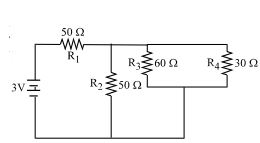
In the circuit shown, the resistances are given in ohms and the battery is assumed ideal with $\mathrm{emf}$ equal to $3.0$ $\mathrm{volts}.$ The resistor that dissipates the most power is
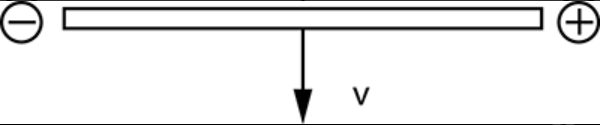
A wire moves with a velocity v through a magnetic field and experiences an induced charge separation as shown in the figure. Then the direction of the magnetic field is
Image
The electrons are emitted in the photoelectric effect from a metal surface
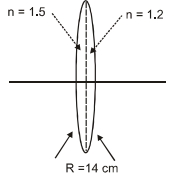
A bi-convex lens is formed with two thin plano-convex lenses as shown in the figure. Refractive index $n$ of the first lens is $1.5$ and that of the second lens is $1.2$. Both the curved surfaces are of the same radius of curvature $R=$ $14 \ cm$. For this bi-convex lens, for an object distance of $40 \ cm$, the image distance will be
A metal wire of specific resistance $64 \times 10^{-6} \mathrm{ohm}-\mathrm{cm}$ and length 198 cm has a resistance of 7 ohm, the radius of the wire will be
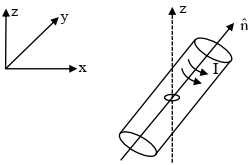
A small circular loop of area $A$ and resistance $R$ is fixed on a horizontal $x y$-plane with the center of the loop always on the axis $\hat{n}$ of a long solenoid. The solenoid has $m$ turns per unit length and carries current $I$ counterclockwise as shown in the figure. The magnetic field due to the solenoid is in $\hat{ n }$ direction. $List-I$ gives time dependences of $\hat{ n }$ in terms of a constant angular frequency $\omega$.

$List-II$ gives the torques experienced by the circular loop at time $t=\frac{\pi}{6 \omega}$, Let $\alpha=\frac{A^2 \mu_0^2 m^2 I^2 \omega}{2 R}$.

$List-I$ $List-II$
($I$) $\frac{1}{\sqrt{2}}(\sin \omega t \hat{j}+\cos \omega t \hat{k})$ ($P$) $0$
($II$) $\frac{1}{\sqrt{2}}(\sin \omega t \hat{j}+\cos \omega t \hat{k})$ ($Q$) $-\frac{\alpha}{4} \hat{i}$
($III$) $\frac{1}{\sqrt{2}}(\sin \omega t \hat{j}+\cos \omega t \hat{k})$ ($R$) $\frac{\alpha}{4} \hat{j}$
($IV$) $\frac{1}{\sqrt{2}}(\sin \omega t \hat{j}+\cos \omega t \hat{k})$ ($S$) $\frac{\alpha}{4} \hat{j}$
  ($T$) $-\frac{3 \alpha}{4} \hat{i}$

Which one of the following options is correct?

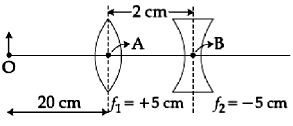
What is the position and nature of image formed by lens combination shown in figure? ($f_1, f_2$ are focal lengths)
Two copper balls, each weighing $10\,g$ are kept in air $10\, cm$ apart. If one electron from every ${10^6}$ atoms is transferred from one ball to the other, the coulomb force between them is (atomic weight of copper is $63.5$)