Question
A transverse harmonic wave on a string is described by
$\text{y}(\text{x, t})=3.0\sin\big(36\text{t}+0.018\text{x}+\frac{\pi}{4}\big)$
where x and y are in cm and t in s. The positive direction of x is from left to right.
What is the initial phase at the origin?
Answer

$\frac{\pi}{4}$
Explanation:
Given,
$\text{y}(\text{x, t})=3\sin\big(36\text{t}+0.018\text{x}+\frac{\pi}{4}\big)$
Initial phase at the origi $=\frac{\pi}{4}$

Need a full question paper?

Generate a complete, print-ready paper with questions like this in minutes — across 16+ boards, with answer keys.

Start Generating Free

Similar questions

A force $\Big(\frac{\text{mv}^2}{\text{r}^2}\Big)$ is acting on a body of mass m moving with a velocity $v$ in a circle of radius $r$. What is the work done by the force in moving the body over half the circumference of the circle?
If the earth is regarded as a hollow sphere, then what is the weight of an object below surface of the earth?
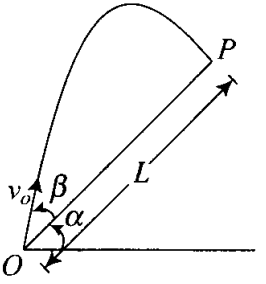
A particle is projected in air at an angle $\beta$ to a surface which itself is inclined at an angle $\alpha$ to the horizontal (Fig.).
  1. Find an expression of range on the plane surface (distance on the plane from the point of projection at which particle will hit the surface).
(Hint: This problem can be solved in two different ways:
  1. Point P at which particle hits the plane can be seen as intersection of its trajectory (parobola) and straight line. Remember particle is projected at an angle $(\alpha+\beta)$ w.r.t. horizontal.
  2. We can take x-direction along the plane and y-direction perpendicular to the plane. In that case resolve g (acceleration due to gravity) in two differrent components, $g_x$ along the plane and $g_y$ perpendicular to the plane. Now the problem can be solved as two independent motions in x and y directions respectively with time as a common parameter.)
Calculate the length of the arc of a circle of radius 31.0cm which subtends an angle of at the centre.
A simple harmonic motion is described by a = -16x where a → acceleration and x is displacement in meter. What is the time period?
Which physical quantity gives the area of the velocity-time graph?
What is the force equation of a SHM?
What is the cause and outcome in a rotational motion?
Should the speed of two artificial satellites of the earth having different masses but the same orbital radius, be the same?
A 50kg man is running at a speed of $18kmh^{-1}$. If all the kinetic energy of the man can be used to increase the temperature of water from 20°C to 30°C, how much water can be heated with this energy?