Question
A transverse harmonic wave travelling on a string is described by $\text{y}(\text{x, t}) = 3.0\sin \Big[(36\text{t}+0.018\text{x})+\frac{\pi}{4}\Big]$ where x and y are in cm and t in sec. The positive direction of x is from left to right.
  1. What is its amplitude and frequency?
  2. What is the initial phase at the origin?
  3. What is the least distance between to successive crest in the wave?
Answer

  1. Travelling wave speed $=\frac{\omega}{\text{k}}=\frac{36}{0.018}$

$=\frac{36}{18}\times10^3$

$=2\times10^3\text{cms}^{-1}$

It travels along the negatice x-axis or from right of left.

  1. Amplitude = 3cm

Frequency $=\frac{\omega}{2\pi}=\frac{36}{2\pi}$

$=\frac{18}{\pi}\text{Hz}$

  1. Initial phase $=\frac{\pi}{4}$
  2. Distabce betweeb successive crests $=\lambda =\frac{2\pi}{\text{k}}$

$=\frac{2\pi}{0.018}=3.5\text{m}$

Need a full question paper?

Generate a complete, print-ready paper with questions like this in minutes — across 16+ boards, with answer keys.

Start Generating Free

Similar questions

Two vessels have the same base area but different shapes. The first vessel takes twice the volume of water that the second vessel requires to fill upto a particular common height. Is the force exerted by the water on the base of the vessel the same in the two cases ? If so, why do the vessels filled with water to that same height give different readings on a weighing scale?
A particle of mass 0.2kg attached to a massless string is moving in a vertical circle of radius 1.2m. It is imparted a speed of 8ms-1 at the lowest point of its circular path. Does the particle complete the vertical circle? What is the change is tension in the string when the particle moves from the position where the string is vertical to the position where the string is horizontal?
A spherical black body with a radius of 12cm radiates 450W power at 500K. What would be the power of radiation if radius were to be halved and the temperature doubled.
Two neutral particles are kept 1m apart. Suppose by some mechanism some charge is transferred from one particle to the other and the electric potential energy lost is completely converted into a photon. Calculate the longest and the next smaller wavelength of the photon possible.
  1. State the theorem of parallel axis. Using it derive an expression to find the moment of inertia of a rod of mass M, length 1 about an axis perpendicular to it passing through one of its ends.
  2. Find the centre of mass of a uniform L shaped lamina (a thin flat plate) with dimension as shown in fig. The mass of lamina is 3kg.
A vessel containing one mole of a monatomic ideal gas (molecular weight = 20gmol-1) is moving on a floor at a speed of 50ms-1. The vessel is stopped suddenly. Assuming that the mechanical energy lost has gone into the internal energy of the gas, find the rise in its temperature.
If there are 'n' particles of masses m1, m2, ...mn distributed in space, write expressions for x, y and z coordinates of COM.
popular game in Indian villages is goli which is played with small glass balls called golis. The goli of one player is situated at a distance of 2.0m from the goli of the second player. This second player has to project his goli by keeping the thumb of the left hand at the place of his goli, holding the goli between his two middle fingers and making the throw. If the projected goli hits the goli of the first player, the second player wins. If the height from which the goli is projected is 19.6cm from the ground and the goli is to be projected horizontally, with what speed should it be projected so that it directly hits the stationary goli without falling on the ground earlier?
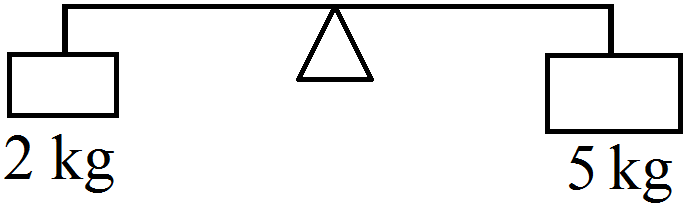
A light rod of length 1m is pivoted at its centre and two masses of 5kg and 2kg are hung from the ends as shown in figure. Find the initial angular acceleration of the rod assuming that it was horizontal in the beginning.

To simulate car accidents, auto manufacturers study the collisions of moving cars with mounted springs of different spring constants. Consider a typical simulation with a car of mass $1000 kg$ moving with a speed $18.0 km / h$ on a smooth road and colliding with a horizontally mounted spring of spring constant $5.25 \times 10^3 N m ^{-1}$. What is the maximum compression of the spring?