Question
A transverse section of a trunk shows alternate concentric rings
  1. What are these rings known as?
  2. How are these rings formed?
  3. What is the significance of these alternate concentric rings?
OR
A transverse section of a stem of a tree shows concentric rings. How are these rings formed? Statethe significance of these rings.
Answer

  1. These rings are known as annual ring.
  2.  
  • The activity of cambium is influenced by internal factors as well as external factors.
  • In spring season, the cambium is active and produces large number of xylary elements, with larger diameter; the wood formed in spring, is called early wood or spring wood.
  • In winter, the cambium is less active and produces few xylary elements, that too with narrow vessels; the wood formed in winter, is called late wood or autumn wood.
  • These two types of wood appear as alternate concentric rings and constitute the annual rings.
  1. The age of a tree can be calculated by counting the number of annual rings.

Need a full question paper?

Generate a complete, print-ready paper with questions like this in minutes — across 16+ boards, with answer keys.

Start Generating Free

Similar questions

Make a list of some proteins and their functions.
The Rhizobium lives in a symbiotic association with leguminous plants. This kind of relationship teaches us which of the following lessons? What are the benefits of cooperation for humans?
  1. We should learn to take benefit from others.
  2. Cooperation is always good for mutual benefit.
  3. We should always maintain friendly relations with our neighbours.
How does water moves within the root?
How are the terms ‘critical concentration’ and ‘deficient’ different from each other in terms of concentration of an essential element in plants? Can you find the values of ‘critical concentration’ and ‘deficient’ for minerals – Fe and Zn.
The cross-section of a plant material showed the following features when viewed under the microscope.
  1. The vascular bundles were radially arranged.
  2. Four xylem strands with exarch condition of protoxylem.
To which organ should it be assigned?
What are the main structures in a monocot seeds? Describe with the help of suitable diagram.
  1. List out some flightless birds.
  2. Describe briefly any four with their important features.
  3. Write the name of any two extinct flightless birds.
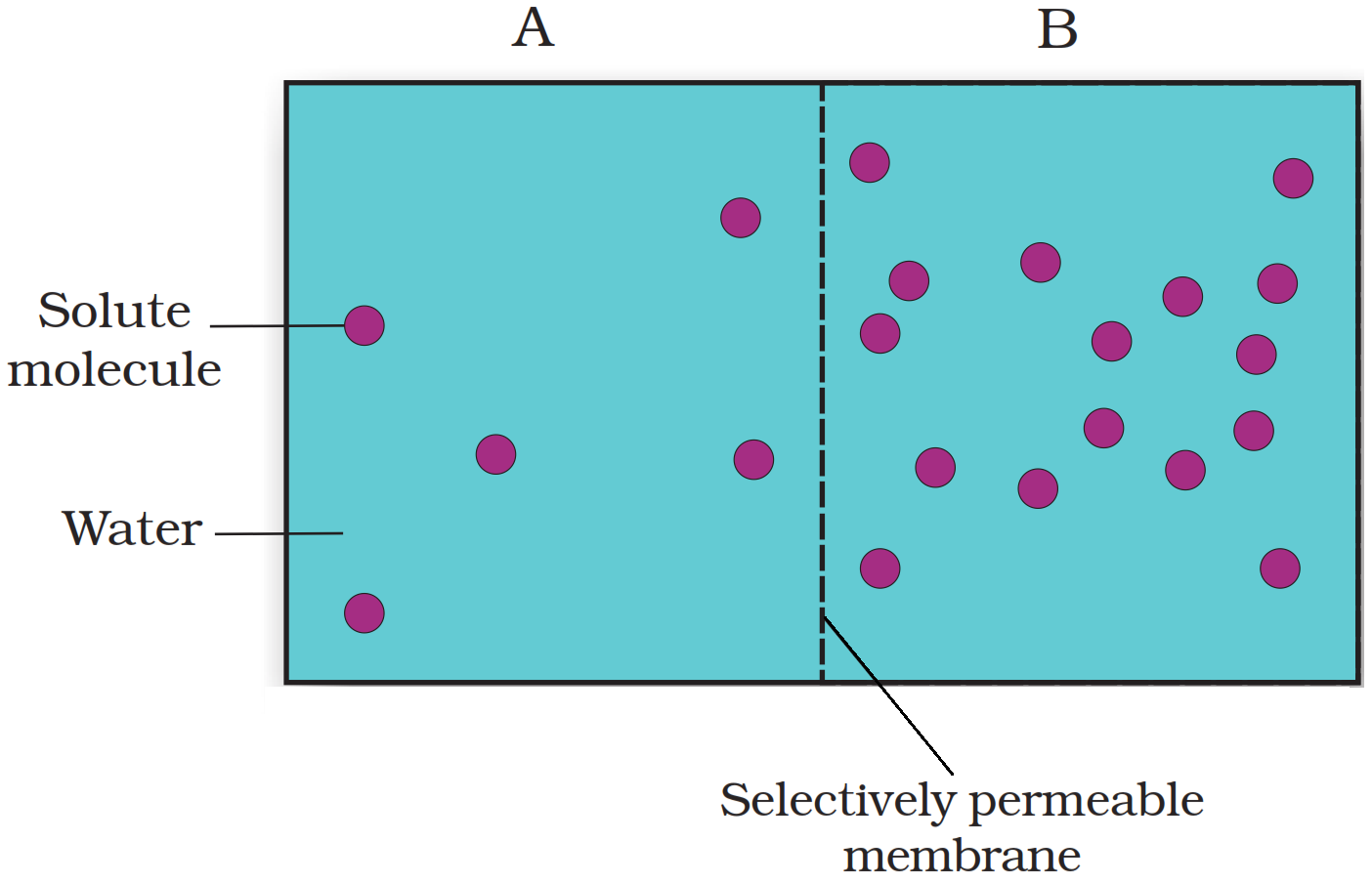
Study the figure given above, in which the two chambers A and B containing solutions are separated by a semipermeable membrane.
  1. Solution of which chamber has a lower water potential?
  2. Solution of which chamber has a lower solute potential?
  3. In which direction will osmosis occur?
  4. Which solution has a higher solute potential?
  5. At equilibrium which chamber will have lower water potential?
  6. If one chamber has a $\Psi$ of -2000 kPa and the other -1000 kPa, which is the chamber that has the higher $\Psi?$
What is plasma? Write the functions of plasma.
Explain the difference between interfascicular cambium and intrafascicular cambium.