MCQ
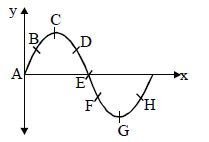
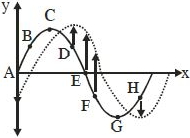
A transverse wave is travelling along a string from left to right. The adjoining figure represents the shape of the string at a given instant. At this instant, among the following, choose the wrong statement.
  • A
    Points $D, E$ and $F$ have upwards positive velocity
  • B
    Points $A, B$ and $H$ have downwards negative velocity
  • C
    Points $C$ and $G$ have zero velocity
  • Points $A$ and $E$ have minimum velocity
Answer

Correct option: D.
Points $A$ and $E$ have minimum velocity
d
Particle velocity $, \frac{\mathrm{dy}}{\mathrm{dt}}=-v\left(\frac{\mathrm{dy}}{\mathrm{dx}}\right)$

or $\frac{\mathrm{dy}}{\mathrm{dt}}=-$ wave velocity $\times$ slope of the wave

$(1)$ For upward velocity, $v_{\mathrm{Pa}}=+\mathrm{ve},$ so slope must be negative which is at the points $D,$ $\mathrm{E}$ and $\mathrm{F}$

$(2)$ For downward velocity, $v_{\mathrm{Pa}}=-\mathrm{ve},$ so slope must be positive which is at the points $A, B$ and $\mathrm{H}$

$(3)$ For zero velocity, slope must be zero which is at $\mathrm{C}$ and $\mathrm{G}$

$(4)$ For maximum magnitude to velocity. $|$ slope $|=$ maximum, which is at $A$ and $\mathrm{E}$. Hence, alternative is wrong.

Need a full question paper?

Generate a complete, print-ready paper with questions like this in minutes — across 16+ boards, with answer keys.

Start Generating Free

Similar questions

$Assertion :$ The isothermal curves intersect each other at a certain point.
$Reason :$ The isothermal change takes place slowly, so, the isothermal curves have very little slope.
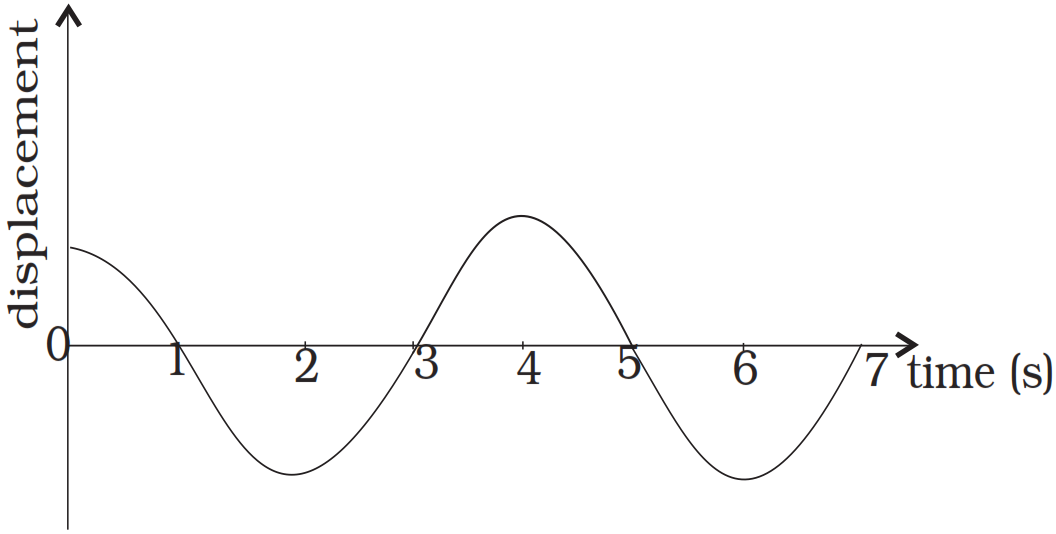
Displacement vs. time curve for a particle executing $\text{S.H.M.}$ is shown in Fig. Choose the correct statements:
What is the value of $\frac{R}{{{C_P}}}$ for diatomic gas
A cylinder is rolling down on an inclined plane of inclination $60^{\circ}$. It's acceleration during rolling down will be $\frac{\mathrm{x}}{\sqrt{3}} \mathrm{~m} / \mathrm{s}^2$, where $\mathrm{x}=$___________. (use $\mathrm{g}=10 \mathrm{~m} / \mathrm{s}^2$ ).
If the current is doubled, the deflection is also doubled in:
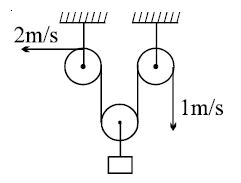
Find the velocity of the hanging block if the velocities of the free ends of the rope are as indicated in the figure.
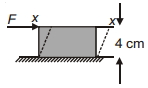
A steel plate of face area $1 \,cm ^2$ and thickness $4 \,cm$ is fixed rigidly at the lower surface. A tangential force $F=10 \,kN$ is applied on the upper surface as shown in the figure. The lateral displacement $x$ of upper surface w.r.t. the lower surface is .............. $m$ (Modulus of rigidity for steel is $8 \times 10^{11} \,N / m ^2$ )
A satellite of mass $m$, initially at rest on the earth, is launched into a circular orbit at a height equal to the radius of the earth. The minimum energy required is
What will be the average value of energy along one degree of freedom for an ideal gas in thermal equilibrium at a temperature $T \,?\left( k _{ B }\right.$ is Boltzmann constant)
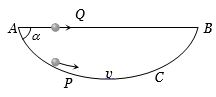
A particle $P$ is sliding down a frictionless hemispherical bowl. It passes the point $A$ at $t = 0$. At this instant of time, the horizontal component of its velocity is $v$. A bead $Q$ of the same mass as $P$ is ejected from $A$ at $t = 0$ along the horizontal string $AB$ (see figure) with the speed $v$. Friction between the bead and the string may be neglected. Let ${t_P}$ and ${t_Q}$ be the respective time taken by $P$ and $Q$ to reach the point $B$. Then