MCQ
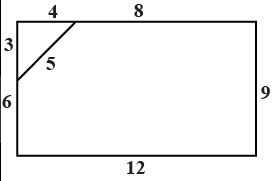
A triangular corner is cut from a rectangular piece of paper and the resulting pentagon has sides $5,6,8,9, 12$ in some order. The ratio of the area of the pentagon to the area of the rectangle is
  • A
    $\frac{11}{18}$
  • B
    $\frac{13}{18}$
  • C
    $\frac{15}{18}$
  • $\frac{17}{18}$

Answer

Correct option: D.
$\frac{17}{18}$
d
(d)

We have,

A rectangular corner is cut form a rectangular piece of paper.

Area of rectangle

$\quad=12 \times 9=108 \text { sq units }$

$\text { Area of pentagon }$

$\qquad \quad=\text { Area of rectangle }-\text { Area of triangle }$

$\quad=108-6=102$

$\therefore \text { Ratio }=\frac{102}{108}=\frac{17}{18}$

Need a full question paper?

Generate a complete, print-ready paper with questions like this in minutes — across 16+ boards, with answer keys.

Start Generating Free

Similar questions

Find the principal value of $\sec ^{-1}\left(\frac{2}{\sqrt{3}}\right)$
How many words can be formed by taking $3$ consonants and $2$ vowels out of $5$ consonants and $4$ vowels
If the distances from the origin to the centres of the three circles ${x^2} + {y^2} - 2{\lambda _i}\,x = {c^2},(i = 1,\,2,\,3)$ are in $G. P.$, then the lengths of the tangents drawn to them from any point on the circle ${x^2} + {y^2} = {c^2}$ are in
If $\mathop {\lim }\limits_{x \to 1} {\sin ^{ - 1}}\left( {\frac{k}{{\ln x}} - \frac{k}{{x - 1}}} \right)$ exist, then the number of integers in the range of $k$ , is
If $x$ is so small that ${x^3}$ and higher powers of $x$ may be neglected, then $\frac{{{{(1 + x)}^{\frac{3}{2}}} - {{\left( {1 + \frac{1}{2}x} \right)}^3}}}{{{{(1 - x)}^{\frac{1}{2}}}}}$ may be approximated as
If $p$ and $q$ are non-zero real numbers and ${\alpha ^3} + {\beta ^3} =  - p$, $\alpha \beta  = q$, then a quadratic equation whose roots are $\frac{{{\alpha ^2}}}{\beta },\frac{{{\beta ^2}}}{\alpha }$ is
If $\tan \,n\theta = \tan m\theta $, then the different values of $\theta $ will be in
Let $A$ denote the matrix $\left[\begin{array}{ll}0 & i \\ i & 0\end{array}\right]$, where $i^2=-1$, and let $I$ denote the identity matrix $\left[\begin{array}{ll}1 & 0 \\ 0 & 1\end{array}\right]$. Then, $I+A+A^2+\ldots+A^{2010}$ is
If the scalar projection of the vectors $xi - j + k$ on the vector $2i - j + 5k$ is $\frac{1}{{\sqrt {30} }}$ then value of $x$  is equal to
Let $P$ be an $m \times m$ matrix such that $P^2=P$. Then, $(I+P)^n$ equals