Question
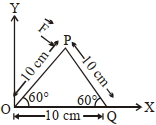
A triangular plate is shown. A force $\overrightarrow{ F }=4 \hat{ i }-3 \hat{ j }$ is applied at point $P$. The torque at point $P$ with respect to point $'O'$ and $'Q'$ are
Answer

$\overrightarrow{ F }=4 \hat{ i }-3 \hat{ j }$

$\overrightarrow{ r }_{1}=5 \hat{ i }+5 \sqrt{3} \hat{ j } \& \overrightarrow{ r }_{2}=-5 \hat{ i }+5 \sqrt{3} \hat{j}$

Torque about $'O'$

$\vec{\tau}_{0}=\overrightarrow{ r }_{1} \times \overrightarrow{ F }=(-15-20 \sqrt{3}) \hat{ k }=(15+20 \sqrt{3})(-\hat{ k })$

Torque about $'Q'$

$\vec{\tau}_{Q}=\overrightarrow{ r }_{2} \times \overrightarrow{ F }=(-15+20 \sqrt{3}) \hat{ k }=(15-20 \sqrt{3})(-\hat{ k })$

Need a full question paper?

Generate a complete, print-ready paper with questions like this in minutes — across 16+ boards, with answer keys.
Start Generating Free

Similar questions

To avoid slipping while walking on ice, one should take smaller steps because of the
An object of mass $0.2 \mathrm{~kg}$ executes simple harmonic motion along $\mathrm{x}$ axis with frequency of $\left(\frac{25}{\pi}\right) \mathrm{Hz}$. At the position $\mathrm{x}=0.04 \mathrm{~m}$ the object has kinetic energy $0.5 \mathrm{~J}$ and potential energy $0.4 \mathrm{~J}$ The amplitude of oscillation is ............ cm.
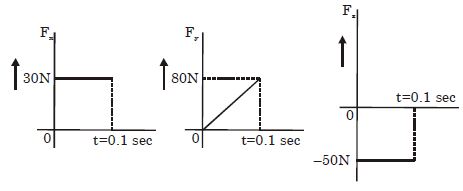
A particle is acted upon by a force whose  component's variations with time are shown in diagrams. Then the magnitude of change in momentum of the particle in $0.1\,\,sec$ will be :-
At room temperature a diatomic gas is found to have an $r.m.s.$ speed of $1930\,ms^{-1}$. The gas is
A uniform thin rod $AB$ of length $L$ has linear mass density $\mu \left( x \right) = a + \frac{{bx}}{L}$ , where $x$ is measured from $A$. If the $CM$ of the rod lies at a distance of $\left( {\frac{7}{12}} \right)L$ from $A$, then $a$ and $b$ are related as
Vanillin compound obtained from vanilla beans, has total sum of oxygen atoms and $\pi$ electrons is . . . 
A $5000\, kg$ rocket is set for vertical firing. The exhaust speed is $800\,m{s^{ - 1}}$. To give an initial upward acceleration of $20\,m{s^{ - 2}}$, the amount of gas ejected per second to supply the needed thrust will be ........... $kg\,{s^{ - 1}}$ $(g = 10\,m{s^{ - 2}})$
In double slit experiment, the angular width of the fringes is $0.20^o $ for the sodium light ($\lambda =5890 Å$). In order to increase the angular width of the fringes by $10\%$, the necessary change in the wavelength is
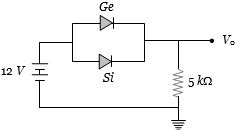
Ge and Si diodes conduct at $0.3 \,V$ and $0.7\, V$ respectively. In the following figure if Ge diode connection are reversed, the valve of $V0$ changes by.....$V$
The curvature radii of a concavo-convex glass lens are $20\, cm$ and $60\, cm$. The convex surface of the lens is silvered. With the lens horizontal, the concave surface is filled with water. The focal length of the effective mirror is $(\mu$ of glass $= 1.5$, $\mu$ of water $= 4/3)$