MCQ
A triglyceride can have how many different acyl groups?
- A$3$
- B$2$
- ✓$1$
- D$4$
$Cl\, \leftarrow \,\mathop {C{H_2}C{H_2}OH}\limits_{Stronger\,\,acid} \to \,$ $\,Cl\,\leftarrow \,\underset{\begin{smallmatrix}
-ve\,\,charge\,\,on\,\,O \\
dispersed\,\,hence
\\
conjugate\,\,base,\,stable
\end{smallmatrix}}{\mathop{C{{H}_{2}}C{{H}_{2}}{{O}^{-}}\,}}\,+\,{{H}^{+}}$
$\underset{Weaker \,\,acid}{\mathop{C{{H}_{3}}C{{H}_{2}}OH}}\,\,\to \underset{\begin{smallmatrix}
-\,\,ve\,\,charge\,\,\operatorname{int}ensified, \\
\,\,\,\,\,\,\,\,hence\,\,conjugatte
\\
\,\,\,\,\,\,\,\,base\,\,unstable
\end{smallmatrix}}{\mathop{C{{H}_{3}}\to \,C{{H}_{2}}{{O}^{-}}\,+}}\,\,{{H}^{+}}$
Generate a complete, print-ready paper with questions like this in minutes — across 16+ boards, with answer keys.
What will be the electrode potential at $pH = 3$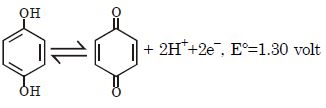
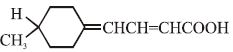
is an example of which of the following types of reactions