MCQ
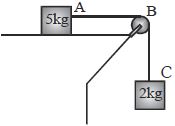
A trolley of mass $5\,kg$ on a horizontal smooth surface is pulled by a load of mass $2\,kg$ by means of uniform rope $ABC$ of length $2\,m$ and mass $ 1\,kg.$ As the load falls from $BC = 0$ to $BC = 2\,m,$ its acceleration in $m/s^2$ changes from
  • A
    $\frac{{20}}{6}$ to $\frac{{20}}{5}$
  • $\frac{{20}}{8}$ to $\frac{{30}}{8}$
  • C
    $\frac{{20}}{5}$ to $\frac{{30}}{6}$
  • D
    None of the above

Answer

Correct option: B.
$\frac{{20}}{8}$ to $\frac{{30}}{8}$
b
For $\quad \mathrm{BC}=0, \mathrm{a}=\frac{2 \mathrm{g}}{2+5+1}=\frac{\mathrm{g}}{4}=\frac{10}{4}=\frac{20}{8} \mathrm{ms}^{-2}$
For $\quad \mathrm{BC}=2 \mathrm{m}, \mathrm{a}=\frac{(2+1) \mathrm{g}}{2+5+1}=\frac{3 \mathrm{g}}{8}=\frac{30}{8} \mathrm{ms}^{-2}$

Need a full question paper?

Generate a complete, print-ready paper with questions like this in minutes — across 16+ boards, with answer keys.

Start Generating Free

Similar questions

A wave pulse, travelling on a two -piece string, gets partially reflected and partially transmitted at the junction. The reflected wave is inverted in shape as compared to the incident one. If the incident wave has wavelengt $\lambda$ and the transmitted wave $\lambda'.$
At time $t=0$, a car moving along a straight line has a velocity of $16 \;m / s$. It slows down with an acceleration of $-0.5 t \;m / s ^2$, where $t$ is in second. Mark the correct statement (s).
A rectangular block of size $10\,cm \times 8\,cm \times 5\,cm$ is kept in three different positions $P, Q$ and $R$ in turn as shown in the figure. In each case, the shaded area is rigidly fixed and a definite force $F$ is applied tangentially to the opposite face to deform the block. The displacement of the upper face will be
A non.monochromatic light is used in an experiment on photoelectric effect. The stopping potential:
A body of mass $1\, kg$ is under a force, which causes a displacement in it is given by $x = \frac{{{t^3}}}{3}$ (in $m$). Find the work done by the force in first second ............ $\mathrm{J}$
The coefficient of restitution $e$ for a perfectly inelastic collision is
A body travels uniformly a distance of $(13.8 \pm 0.2) m$ in a time $(4.0 \pm 0.3) s$. Its velocity with error limits and percentage error is
If ${C_V} = 4.96cal/mole\, K$, then increase in internalenergy when temperature of $2$ moles of this gas is increased from $340 K$ to $342 K$ ....... $cal$
Length cannot be measured by
The magnitude of the centripetal force acting on a body of mass $m$ executing uniform motion in a circle of radius $r$ with speed $v$ is