MCQ
A tube with both open end its fundamental frequency is n. If half of tube is dipped in water vertically the fundamental frequency of air column.
  • A
    $2n$
  • $n$
  • C
    $n/2$
  • D
    $3n/2$

Answer

Correct option: B.
$n$
(B)

Need a full question paper?

Generate a complete, print-ready paper with questions like this in minutes — across 16+ boards, with answer keys.

Start Generating Free

Similar questions

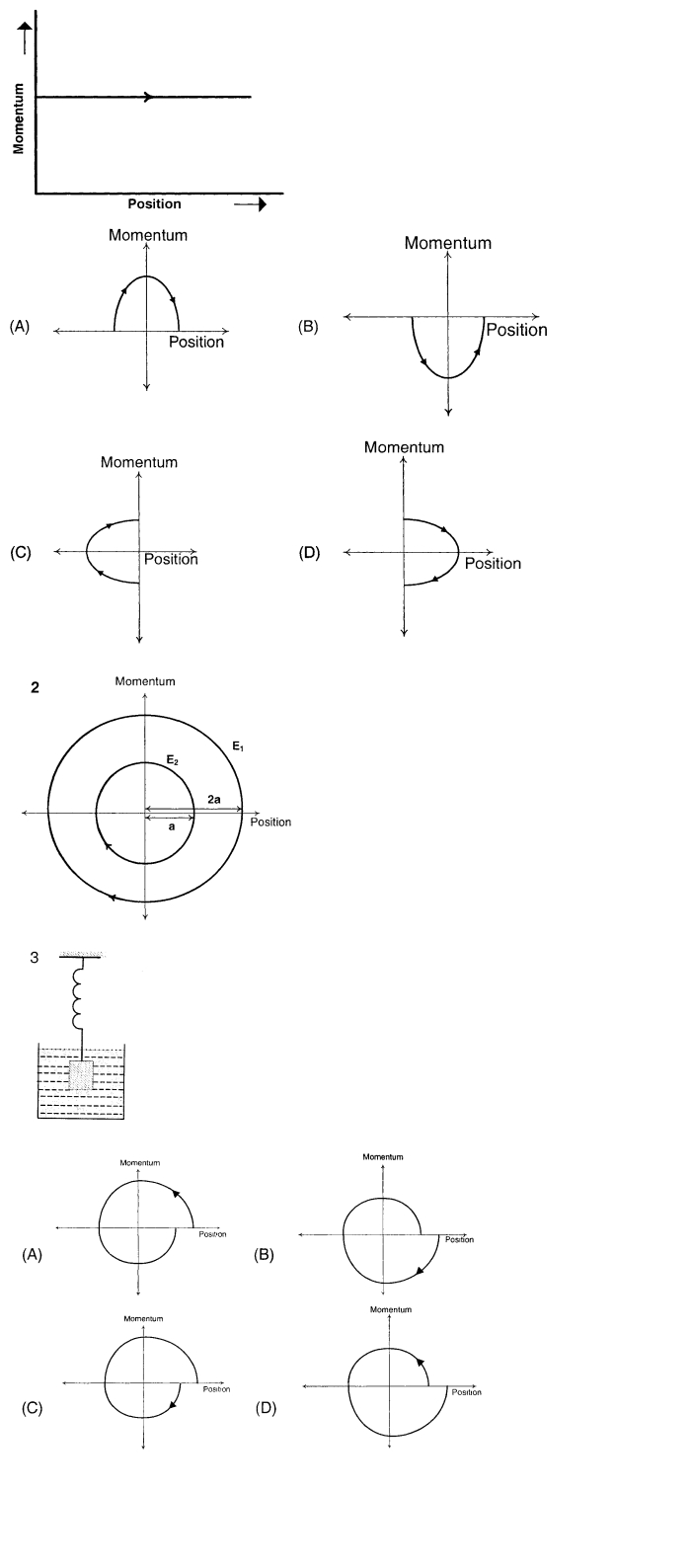
Phase space diagrams are useful tools in analyzing all kinds of dynamical problems. They are especially useful in studying the changes in motion as initial position and momentum are changed. Here we consider some simple dynamical systems in one-dimension. For such systems, phase space is a plane in which position is plotted along horizontal axis and momentum is plotted along vertical axis. The phase space diagram is $x(t)$ vs. $p(t)$ curve in this plane. The arrow on the curve indicates the time flow. For example, the phase space diagram for a particle moving with constant velocity is a straight line as shown in the figure. We use the sign convention in which position or momentum upwards (or to right) is positive and downwards (or to left) is negative. $Image$

$1.$ The phase space diagram for a ball thrown vertically up from ground is

mcq $Image$

$2.$ The phase space diagram for simple harmonic motion is a circle centered at the origin. In the figure, the two circles represent the same oscillator but for different initial conditions, and $E_1$ and $E_2$ are the total mechanical energies respectively. Then $Image$

$(A)$ $ E_1=\sqrt{2} E_2$ $(B)$ $ E_1=2 E_2$

$(C)$ $ E_1=4 E_2$ $(D)$ $ E_1=16 E_2$

$3.$ Consider the spring-mass system, with the mass submerged in water, as shown in the figure. The phase space diagram for one cycle of this system is $Image$

mcq $Image$

Give the answer question $1,2$ and $3.$
A simple pendulum is oscillating without damping. When the displacement of the bob is less than maximum, its acceleration vector $\vec a$ is correctly shown in
An airplane must reach a take of speed of $80\ m/ s$ in a $1000m$ long runway. What minimum constant acceleration is required$? ($in $m/ s^2):$
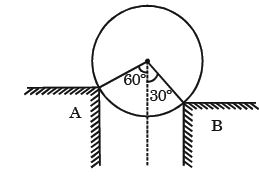
A smooth cylinder of mass $m$ and radius $R$  is resting on two corner edges  $A$  and $B$  as shown in fig. The relation between normal reaction at the edges $A$ and $B$  is
The earth is an approximate sphere. If the interior contained matter which is not of the same density everywhere, then on the surface of the earth, the acceleration due to gravity.
A raised hammer possesses:
The velocity and acceleration vectors of a particle undergoing circular motion are $\overrightarrow{ v }=2 \hat{ i } m / s$ and $\overrightarrow{ a }=2 \hat{ i }+4 \hat{ j } m / s ^2$ respectively at an instant of time. The radius of the circle is $........\,m$
An electrically maintained tuning fork vibrates with constant frequency and constant amplitude. If the temperature of the surrounding air increases but pressure remains constant, the sound produced will have:
  1. Larger wavelength.
  2. Larger frequency.
  3. Larger velocity.
  4. Larger time period.
An object of mass $4.237 g$ occupies a volume $1.72 cm ^3$. The density of the object to appropriate significant figures is ......... $g cm ^{-3}$
Three moles of an ideal gas $\left( {{C_P} = \frac{7}{2}R} \right)$ at pressure ${P_A}$ and temperature ${T_A}0$ is isothermally expanded to twice its initial volume. It is then compressed at constant pressure to its original volume. Finally the gas is compressed at constant volume to its original pressure ${P_A}.$ The correct $P-V$ and $P-T$ diagrams indicating the process are