MCQ
A tuning fork sends sound waves in air. If the temperature of the air increases, which of the following parameters will change?
  • A
    Displacement amplitude.
  • B
    Frequency.
  • Wavelength.
  • D
    Time period.

Answer

Correct option: C.
Wavelength.
The velocity of a sound wave varies with temperature as follows:
$\text{v}\propto\sqrt{\text{T}}$
As the temperature increases, the speed also increases. However, since the frequency remains the same, its wavelength changes.

Need a full question paper?

Generate a complete, print-ready paper with questions like this in minutes — across 16+ boards, with answer keys.
Start Generating Free

Similar questions

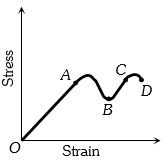
In the below graph, point $B$ indicates
An electric motor exerts a force of $40 N$  on a cable and pulls it by a distance of $30 m$  in one minute. The power supplied by the motor (in Watts) is
Two planets revolve round the sun with frequencies ${N_1}$ and ${N_2}$ revolutions per year. If their average orbital radii be ${R_1}$ and ${R_2}$ respectively, then ${R_1}/{R_2}$ is equal to
The work done by a force $\vec F = \left( { - 6{x^3}\hat i} \right)\,N$, in displacing a particle from $x = 4\, m$ to $x = -2\, m$ is  ................ $\mathrm{J}$
Given below are two statements. One is labelled as Assertion $A$ and the other is labelled as Reason $R$.

Assertion A :Two identical balls $A$ and $B$ thrown with same velocity '$u$ ' at two different angles with horizontal attained the same range $R$. If $A$ and $B$ reached the maximum height $h_{1}$ and $h_{2}$ respectively, then $R =4 \sqrt{ h _{1} h _{2}}$

Reason R: Product of said heights.

$h _{1} h _{2}=\left(\frac{u^{2} \sin ^{2} \theta}{2 g }\right) \cdot\left(\frac{u^{2} \cos ^{2} \theta}{2 g }\right)$

Choose the $CORRECT$ answer 
Two rigid boxes containing different ideal gases are placed on a table. Box A contains one mole of nitrogen at temperature $T_0$, while Box contains one mole of helium at temperature $(7/3)$ $T_0$ The boxes are then put into thermal contact with each other, and heat flows between them until the gases reach a common final temperature (ignore the heat capacity of boxes). Then, the final temperature of the gases,$T_f$  in terms of $T_0$ is
A ball is thrown up, it reaches a maximum height and then comes down. If $t_1(t_2 > t_1)$ are the times that the ball takes to be at a particular height then the time taken by the ball to reach the highest point is:
The resultant of two vectors $\vec{A}$ and $\vec{B}$ is perpendicular to $\overrightarrow{\mathrm{A}}$ and its magnitude is half that of $\vec{B}$. The angle between vectors $\vec{A}$ and $\vec{B}$ is . . . . . . 
There is some liquid in a closed bottle. The amount of liquid is continuously decreasing. The vapour in the remaining part:
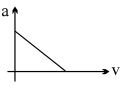
Acceleration versus velocity graph of a particle moving in a straight line starting from rest is as shown in figure. The corresponding velocity-time graph would be