MCQ
A tuning fork vibrating with a sonometer having $20 cm$ wire produces $5$ beats per second. The beat frequency does not change if the length of the wire is changed to $21 cm.$ the frequency of the tuning fork (in Hertz) must be
  • A
    $200$
  • B
    $210$
  • $205$
  • D
    $215$

Answer

Correct option: C.
$205$
c
(c) Let the frequency of tunning fork be $N$
As the frequency of vibration string $ \propto \frac{1}{{{\rm{length}}\;{\rm{of}}{\rm{string}}}}$
For sonometer wire of length $20 cm$, frequency must be $(N + 5)$ and that for the sonometer wire of length $21cm,$ the frequency must be $(N -5)$ as in each case the tunning fork produces $5$ beats/sec with sonometer wire
Hence ${n_1}{l_1} = {n_2}{l_2}$

==> $(N + 5) \times 20 = (N - 5) \times 21$

==> $N = 205Hz.$

Need a full question paper?

Generate a complete, print-ready paper with questions like this in minutes — across 16+ boards, with answer keys.

Start Generating Free

Similar questions

The potential due to an electrostatic charge distribution is $V(r)=\frac{q e^{-\alpha e r}}{4 \pi \varepsilon_{0} r}$, where $\alpha$ is positive. The net charge within a sphere centred at the origin and of radius $1/ \alpha$ is
The most accurate reading of the length of a $6.28 \,cm$ long fibre is ............... $cm$
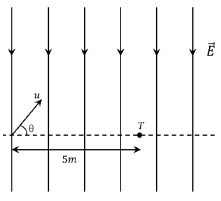
A uniform electric field, $\vec{E}=-400 \sqrt{3} \hat{y}\ NC ^{-1}$ is applied in a region. A charged particle of mass $m$ carrying positive charge $q$ is projected in this region with an initial speed of $2 \sqrt{10} \times 10^6 ms ^{-1}$. This particle is aimed to hit a target $T$, which is $5 m$ away from its entry point into the field as shown schematically in the figure. Take $\frac{ q }{ m }=10^{10} Ckg ^{-1}$. Then$-$
$(A)$ the particle will hit $T$ if projected at an angle $45^{\circ}$ from the horizontal
$(B)$ the particle will hit $T$ if projected either at an angle $30^{\circ}$ or $60^{\circ}$ from the horizontal
$(C)$ time taken by the particle to hit $T$ could be $\sqrt{\frac{5}{6}} \mu s$ as well as $\sqrt{\frac{5}{2}} \mu s$
$(D)$ time taken by the particle to hit $T$ is $\sqrt{\frac{5}{3}} \mu s$
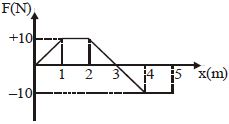
A position dependent force $F$ acting on a particle and its force-position curve is shown in the figure. Work done on the particle, when its displacement $0$ to $5\,m$ is ............. $\mathrm{J}$
A solid cylinder of mass $M$ and radius $R$ rolls without slipping down an inclined plane of length $L$ and height $h$.  What is the speed of its centre of mass when the cylinder reaches its bottom 
A steel wire with mass per unit length $7.0 \times 10^{-3}\,kg\,m ^{-1}$ is under tension of $70\,N$. The speed of transverse waves in the wire will be $.........m/s$
Three waves of equal frequency having amplitudes $10\, \mu m, 4\, \mu m$ and $7\, \mu m$ arrive at a given point with successive phase difference of $\pi/2$. The amplitude of  the resulting wave in $\mu m$ is given by
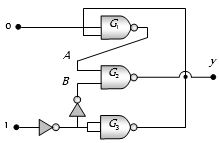
In circuit in following fig. the value of $Y$ is
The pole strength of a bar magnet is $48$  $ampere-metre$ and the distance between its poles is $ 25 \,cm$ . The moment of the couple by which it can be placed at an angle of $30°$ with the uniform magnetic intensity of flux density $0.15 $ $Newton /ampere-metre$ will be.......$Newton × metre$ 
A $bob$ of mass $m$ attached to an inextensible string of length $l$ is suspended from a vertical support. The $bob$ rotates in a horizontal circle with an angular speed $\omega\,  rad/s$ about the vertical. About the point of suspension