MCQ
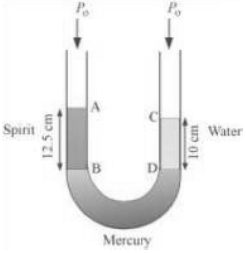
A $U-$tube contains water and methylated spirit separated by mercury. The mercury columns in the two arms are in level with $10.0\; cm$ of water in one arm and $12.5\; cm $ of spirit in the other. if $15.0\; cm$ of water and spirit each are further poured into the respective arms of the tube, what is the difference in the levels  (in $cm$) of mercury in the two arms?

(the specific gravity of spirit is $0.8.)$

  • $0.22$
  • B
    $0.86$
  • C
    $1.22$
  • D
    $2.12$

Answer

Correct option: A.
$0.22$
a
Height of the water column, $h_{1}=10+15=25 cm$

Height of the spirit column, $h_{2}=12.5+15=27.5 cm$

Density of water, $\rho_{1}=1 g cm ^{-3}$

Density of spirit, $\rho_{2}=0.8 g cm ^{-3}$

Density of mercury $=13.6 g cm ^{-3}$

Let $h$ be the difference between the levels of mercury in the two arms.

Pressure exerted by height $h,$ of the mercury column:

$=h \rho g =h \times 13.6 g \ldots(i)$

Difference between the pressures exerted by water and spirit:

$=h_{1} \rho_{1} g -h_{1} \rho_{1} g$

$=g(25 \times 1-27.5 \times 0.8)=3 g \ldots (i i)$

Equating equations ( $i$ ) and (ii), we get:

$13.6 hg =3 g h$

$=0.220588 \approx 0.221 cm$

Hence, the difference between the levels of mercury in the two arms is $0.221 \,cm .$

Need a full question paper?

Generate a complete, print-ready paper with questions like this in minutes — across 16+ boards, with answer keys.

Start Generating Free

Similar questions

A boy is running on the plane road with velocity $v$ with a long hollow tube in his hand. The water is failing vertically downwards with velocity $u$. At what angle to the vertical, he must incline the tube so that the water drops enter it without touching its sides?
A big explosion on the moon cannot be heard on the earth because
$A$ particle of mass $m$ is rotating in a plane is $a$ circular path of radius $r$, its angular momentum is $L$. The centripital force acting on the particle is :
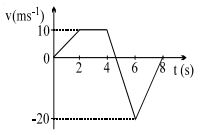
The figure shows a velocity-time graph of a particle moving along a straight line  The correct displacement-time graph of the particle is shown as
The speed of light $(c)$, gravitational constant $(G)$ and planck's constant $(h)$ are taken as fundamental units in a system. The dimensions of time in this new system should be
A ball of mass $0.25\, kg$ attached to the end of a string of length $1.96 \,m$ is moving in a horizontal circle. The string will break if the tension is more than $25 \,N$. ..........  $m/s$ is the maximum speed with which the ball can be moved
The speed of a projectile at its maximum height is $\frac {\sqrt 3}{2}$ times its initial speed. If the range of the projectile is $P$ times the maximum height attained by it, $P$ is equal to
To maintain a rotor at a uniform angular speed of $100\, rad\, s^{-1}$, an engine needs to transmit torque of $100\, Nm$. The power of the engine is
Two substances of densities ${\rho _1}$ and ${\rho _2}$ are mixed in equal volume and the relative density of mixture is $4$. When they are mixed in equal masses, the relative density of the mixture is $3$. The values of ${\rho _1}$ and ${\rho _2}$ are
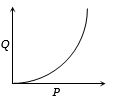
The graph shows the behaviour of a length of wire in the region for which the substance obeys Hook’s law. $P$ and $Q$ represent