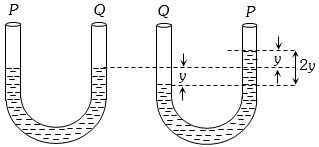
A $ U$ tube of uniform bore of cross-sectional area $A$ has been set up vertically with open ends facing up. Now $m$ gm of a liquid of density $d$ is poured into it. The column of liquid in this tube will oscillate with a period $T$ such that
Diffcult


Download our appand get started for free
Experience the future of education. Simply download our apps or reach out to us for more information. Let's shape the future of learning together!No signup needed.*
Similar Questions
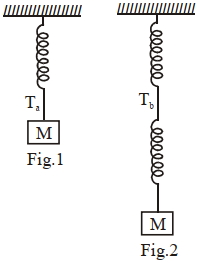
- 1Consider two identical springs each of spring constant $k$ and negligible mass compared to the mass $M$ as shown. Fig. $1$ shows one of them and Fig. $2$ shows their series combination. The ratios of time period of oscillation of the two $SHM$ is $\frac{ T _{ b }}{ T _{ a }}=\sqrt{ x },$ where value of $x$ isView Solution
(Round off to the Nearest Integer)
- 2A brass cube of side $a$ and density $\rho$ is floating in mercury of density $\sigma$. If the cube is displaced a bit vertically, it executes $S.H.M.$ Its time period will beView Solution
- 3A second's pendulum is placed in a space laboratory orbiting around the earth at a height $3R$, where $R$ is the radius of the earth. The time period of the pendulum isView Solution
- 4View SolutionWhich one of the following is a simple harmonic motion
- 5If $< E >$ and $< U >$ denote the average kinetic and the average potential energies respectively of mass describing a simple harmonic motion, over one period, then the correct relation isView Solution
- 6As a body performs $S.H.M.$, its potential energy $U.$ varies with time as indicated inView Solution
- 7A body executes $SHM$ under the influence of one force and has a period $T_1\, second$ and the same body executes $SHM$ with period $T_2\, second$ when under the influence of another force. When bothforces act simultaneously and in the same direction, then the time period of the same body isView Solution
- 8A particle performing $SHM$ is found at its equilibrium at $t = 1\,sec$. and it is found to have a speed of $0.25\,m/s$ at $t = 2\,sec$. If the period of oscillation is $6\,sec$. Calculate amplitude of oscillationView Solution
- 9The displacement $y(t) = A\,\sin \,(\omega t + \phi )$ of a pendulum for $\phi = \frac {2\pi }{3}$ is correctly represented byView Solution
- 10The oscillation of a body on a smooth horizontal surface is represented by the equation $x= Acos$$\omega t$View Solution
where $x=$ displacement at time $t$
$\omega =$ frequency of oscillation
Which one of the following graphs shows correctly the variation $a$ with $t$ ?
Here $a=$ acceleration at time $t$
$T=$ time period