MCQ
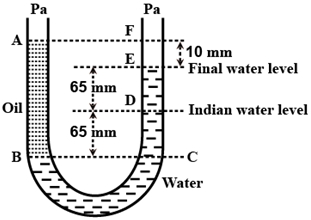
A $U$ tube with both ends open to the atmosphere, is partially filled with water. Oil, which is immiscible with water, is poured into one side until it stands at a distance of $10\,\, mm$ above the water level on the other side. Meanwhile the water rises by $65\,\, mm$ from its original level (see diagram). The density of the oil is ......... $kg/m^3$
  • A
    $800$
  • B
    $425 $
  • $928$
  • D
    $650$

Answer

Correct option: C.
$928$
c
Pressure at point $C$,

${p_C} = {p_a} + {\rho _{water}}g{h_{water'}}$

$where\,{h_{water}} = CE = \left( {65 + 65} \right)mm = 130\,mm$

$pressure\,at\,point\,B,{P_B} = {P_u} + {\rho _{oil}}g{h_{oil}}$

$where\,{h_{oil}} = AB = \left( {65 + 65 + 10} \right)\,mm = 140\,mm$

In liquid, Pressure is same at same liquid level,

${p_B} = {p_c} \Rightarrow {\rho _{oil}}g{h_{oil}} = {\rho _{water}}g\,{h_{water}}$

${\rho _{oil}} = \frac{{130 \times {{10}^3}}}{{140}} = \frac{{13}}{{14}} \times {10^3} = 928.57\,kg\,{m^{ - 3}}$

Need a full question paper?

Generate a complete, print-ready paper with questions like this in minutes — across 16+ boards, with answer keys.

Start Generating Free

Similar questions

If the radius of a star is $R$ and it acts as a black body, what would be the temperature of the star, in which the rate of energy production is Q? ( $\sigma$ stands for Stefan's constant.)
The diameter and height of a cylinder are measured by a meter scale to be $12.6 \pm 0.1\, cm$ and $34.2  \pm  0.1\, cm$, respectively. What will be the value of its volume in appropriate significant figures?
Three liquids of densities $\rho _1,\rho _2$ and $\rho _3$ (with $\rho _1 > \rho _2 > \rho_3),$ having the same value of surface tension $T,$ rise to the same height in three identical capillaries. The angles of contact $\theta_1 \,,\theta_2$ and $\theta_3$ obey  
A block of mass $100 \mathrm{~kg}$ slides over a distance of $10 \mathrm{~m}$ on a horizontal surface. If the co-efficient of friction between the surfaces is $0.4$ , then the work done against friction (in $\mathrm{J}$ ) is :
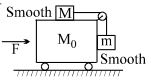
Imagine $a$ situation in which the horizontal surface of block $M_0$ is smooth and its vertical surface is rough with $a$ coefficient of friction $\mu$ Consider a special situation in which both the faces of the block $M_0$ are smooth, as shown in adjoining figure. Mark out the correct statement $(s)$
 Match List $-I$ with List $-II$
  List $-I$   List $-II$
$A$. Coefficient of Viscosity $I$. $[M L^2T^{–2}]$
$B$. Surface Tension  $II$. $[M L^2T^{–1}]$
$C$. Angular momentum $III$. $[M L^{-1}T^{–1}]$
$D$. Rotational Kimeatic energy $IV$. $[M L^0T^{–2}]$
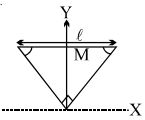
The figure shows an isosceles triangular plate of mass $M$ and base $L$. The angle at the apex is $90^o$. The apex lies at the origin and the base is parallel to $X$ -axis The moment of inertia of the plate about its base parallel to the $x$-axis is
A water fall is $84$ metres high. If half of the potential energy of the falling water gets converted to heat, the rise in temperature of water will be
A spring is compressed between two toy carts of masses $m_1$ and $m_2$. When the toy carts are released the spring exerts equal and opposite forces for the same time $t$ on each toy cart. If the coefficients of friction $\mu $ between the ground and the toy carts are equal, then the displacement of the toy carts are in the ratio
The thermodynamic process, in which internal energy of the system remains constant is ...........