Question
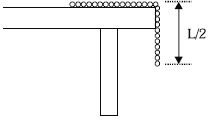
A uniform chain (mass $M,$ length $L$) is released from rest from a smooth horizontal surface as shown in the figure. Velocity of the chain at the instant it completely comes out of the table will be
Answer

$\frac{1}{2}M{V^2} - Mg\frac{L}{2} =  - \frac{M}{2}.g.\frac{L}{4}$ (energy conservation)

Need a full question paper?

Generate a complete, print-ready paper with questions like this in minutes — across 16+ boards, with answer keys.
Start Generating Free

Similar questions

A particle moving with a uniform acceleration travels $24\, m$ and $64\, m$ in the first  two consecutive intervals of $4\, sec$ each. Its initial velocity is......$m / \sec $
The minimum energy required by a hydrogen atom in ground state to emit radiation in Balmer series is nearly :
The magnetic field due to a short magnet at a point on its axis at distance $X \,cm $ from the middle point of the magnet is $200 $ $Gauss$. The magnetic field at a point on the neutral axis at a distance $ X \,cm$  from the middle of the magnet is.....$Gauss$
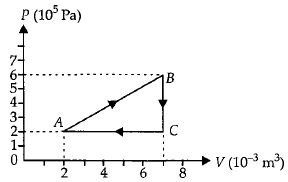
A gas is taken through the cycle $A\to B\to C\to A$ as shown. What is the net work done by the gas ...... $J$ $?$
An opera glass (Gallilean telescope) measures $9 \,cm$ from the objective to the eyepiece. The focal length of the objective is $15\, cm$. Its magnifying power is
Magnetic induction is a
A particle of mass $m$ is moving in a circular orbit under the influence of the central force $F(r)=-k r$, corresponding to the potential energy $V(r)=k r^2 / 2$, where $k$ is a positive force constant and $r$ is the radial distance from the origin. According to the Bohr's quantization rule, the angular momentum of the particle is given by $L=n h$, where $h=h /(2 \pi), h$ is the Planck's constant, and $n$ a positive integer. If $v$ and $E$ are the speed and total energy of the particle, respectively, then which of the following expression($s$) is(are) correct?

$(A)$ $r^2=n h \sqrt{\frac{1}{m k}}$

$(B)$ $v^2=n h \sqrt{\frac{k}{m^3}}$

$(C)$ $\frac{L}{m r^2}=\sqrt{\frac{k}{m}}$

$(D)$ $E=\frac{n h}{2} \sqrt{\frac{k}{m}}$

A closely wound solenoid $80\; cm$ long has $5$ layers of windings of $400$ turns each. The diameter of the solenoid is $1.8\; cm$. If the current carried is $8.0\; A$, estimate the magnitude of $B$ inside the solenoid near its centre.
Arrange the compounds in order of decreasing reactivity for nucleophilic additon reaction

$\mathop {\begin{array}{*{20}{c}}
  {O\,\,\,\,\,\,\,\,\,\,\,\,\,} \\ 
  {||\,\,\,\,\,\,\,\,\,\,\,\,} \\ 
  {C{H_3} - C - C{H_2} - Cl} 
\end{array}}\limits_{\left( I \right)} $    $\underset{(II)}{\mathop{\begin{matrix}
   \,\,\,\,\,\,\,\,\,\,\,\,\,\,\,\,\,\,O  \\
   \,\,\,\,\,\,\,\,\,\,\,\,\,\,\,\,\,\,\,\,\,||\,\,\,  \\
   Cl-C{{H}_{2}}-C-H  \\
\end{matrix}}}\,$

$\mathop {\begin{array}{*{20}{c}}
  O \\ 
  {||} \\ 
  {H - C - H} 
\end{array}}\limits_{\left( {III} \right)} $    $\mathop {\begin{array}{*{20}{c}}
  O \\ 
  {||} \\ 
  {{H_3}C - C - C{H_3}} 
\end{array}}\limits_{\left( {IV} \right)} $

Two coaxial solenoids $1$ and $2$ of the same length are set so that one is inside the other. The number of turns per unit length are ${n_1}$ and ${n_2}$. The currents ${i_1}$ and ${i_2}$ are flowing in opposite directions. The magnetic field inside the inner coil is zero. This is possible when