MCQ
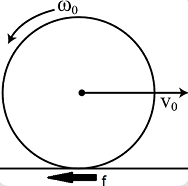
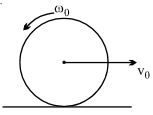
$A$ uniform circular disc placed on $a$ rough horizontal surface has initially a velocity $v_0$ and an angular velocity $\omega_0$ as shown in the figure. The disc comes to rest after moving some distance in the direction of motion. Then $\frac{{{v_0}}}{{r{\omega _0}}}$ is
  • $\frac{1}{2}$
  • B
    $1$
  • C
    $\frac{3}{2}$
  • D
    $2$

Answer

Correct option: A.
$\frac{1}{2}$
a
Slipping will take place and to oppose the relative motion between the disc and the ground, friction will act in the shown direction.

So we can write $f=m a$ So $a=\frac{f}{m}$

$f \cdot r=I \alpha$

For the disc $I=\frac{1}{2} m r^{2}$

$\alpha=\frac{2 f}{m r}$

If the disc stops moving after travelling for a while, both $v_{0}$ and $\omega_{0}$ become zero at the same time.

If time $t$ required to stop, we can write

$v_{0}-a t=0$ and $\omega_{0}-\alpha t=0$

$\therefore \frac{v_{0}}{a}=\frac{\omega_{0}}{\alpha}$

$\therefore \frac{v_{0} m}{f}=\frac{\omega_{0} r m}{2 f}$

$\therefore \frac{v_{0}}{\omega_{0} r}=\frac{1}{2}$

Need a full question paper?

Generate a complete, print-ready paper with questions like this in minutes — across 16+ boards, with answer keys.

Start Generating Free

Similar questions

A car is moving at a speed of $40\,m/s$ on a circular track of radius $400\,m.$ This speed is increasing at the rate of $3\,m/s^2.$ The acceleration of car is  ........ $m/s^2$
The instantaneous angular position of a point on a rotating wheel is given by the  equation $\theta (t) = 2t^3-6t^2$. The torque on the wheel becomes zero at $t=$ ....... $\sec.$
The gases carbon monoxide (CO) and nitrogen (N2) at the same temperature have kinetic energies E1 and E2, respectively. Then,
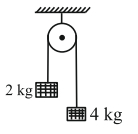
Two blocks of mass $2 \mathrm{~kg}$ and $4 \mathrm{~kg}$ are connected by a metal wire going over a smooth pulley as shown in figure. The radius of wire is $4.0 \times 10^{-5}$ $\mathrm{m}$ and Young's modulus of the metal is $2.0 \times 10^{11} \mathrm{~N} / \mathrm{m}^2$. The longitudinal strain developed in the wire is $\frac{1}{\alpha \pi}$. The value of $\alpha$ is [Use $\mathrm{g}=10 \mathrm{~m} / \mathrm{s}^2$ )
The capacitance of a capacitor does not depend on:
  1. The shape of the plates.
  2. The size of the plates.
  3. The charges on the plates.
  4. The separation between the plates.
A standing wave pattern of amplitude $A$ in a string of length $L$ shows $2$ nodes (plus those at two ends). If one end of the string corresponds to the origin and $v$ is the speed of progressive wave, the disturbance in the string, could be represented (with appropriate phase) as: 
Which of the following processes is irreversible?
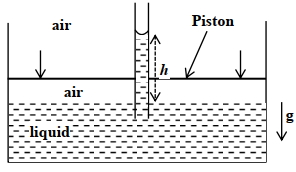
An incompressible liquid is kept in a container having a weightless piston with a hole. A capillary tube of inner radius $0.1 \mathrm{~mm}$ is dipped vertically into the liquid through the airtight piston hole, as shown in the figure. The air in the container is isothermally compressed from its original volume $V_0$ to $\frac{100}{101} V_0$ with the movable piston. Considering air as an ideal gas, the height $(h)$ of the liquid column in the capillary above the liquid level in $\mathrm{cm}$ is. . . . . . .

[Given: Surface tension of the liquid is $0.075 \mathrm{Nm}^{-1}$, atmospheric pressure is $10^5 \mathrm{~N} \mathrm{~m}^{-2}$, acceleration due to gravity $(g)$ is $10 \mathrm{~m} \mathrm{~s}^{-2}$, density of the liquid is $10^3 \mathrm{~kg} \mathrm{~m}^{-3}$ and contact angle of capillary surface with the liquid is zero]

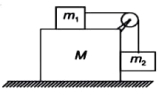
In the given arrangement all surfaces are smooth. What acceleration should be given to the system, for which the block $m_2$ doesn't slide down?
A steel tape gives correct measurement at $20^o C$. A piece of wood is being measured with the steel tape at $0^o C$. The reading is $25 \,\,cm$ on the tape, the real length of the given piece of wood must be: