MCQ
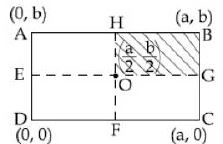
A uniform rectangular thin sheet $ABCD$ of mass $M$ has length $a$ and breadth $b$, as shown in the figure. If the shaded portion $HBGO$ is cut off, the coordinates of the centre of mass of the remaining portion will be
  • A
    $\left( {\frac{{5a}}{3},\frac{{5b}}{3}} \right)$
  • B
    $\left( {\frac{{2a}}{3},\frac{{2b}}{3}} \right)$
  • C
    $\left( {\frac{{3a}}{4},\frac{{3b}}{4}} \right)$
  • $\left( {\frac{{5a}}{12},\frac{{5b}}{12}} \right)$
Answer

Correct option: D.
$\left( {\frac{{5a}}{12},\frac{{5b}}{12}} \right)$
d
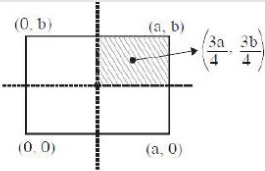
$x = \frac{{M\frac{a}{2} - \frac{M}{4} \times \frac{{3a}}{4}}}{{M - \frac{M}{4}}}$

$ = \frac{{\frac{a}{2} - \frac{{3a}}{{16}} \times \frac{{3a}}{4}}}{{\frac{3}{4}}} = \frac{{\frac{{5a}}{{16}}}}{{\frac{3}{4}}} = \frac{{5a}}{{12}}$

$y = \frac{{M\frac{b}{2} - \frac{M}{4} \times \frac{{3b}}{4}}}{{M - \frac{M}{4}}} = \frac{{5b}}{{12}}$

Need a full question paper?

Generate a complete, print-ready paper with questions like this in minutes — across 16+ boards, with answer keys.

Start Generating Free

Similar questions

Match the corresponding entries of column $I$  with column $II$. [Where $m$ is the magnification produced by the mirror]

 $\begin{array}{|l|l|} \hline Column\,\,-I  & Column\,\,-\,\,II\,\, \\ \hline 1.\,\,m=-2  & a.\,\,Convex\,\,mirror \\ \hline 2.\,\,m=\,\,\frac{-1}{2} & b.\,\,Concave\,\,mirror \\ \hline 3.\,\,m=+2  & c.\,\,Real\,\,Image \\ \hline 4.\,\,m=\,\,\frac{+1}{2} & d.\,\,Virtual\,\,image \\ \hline \end{array}$

A car is moving on a circular path of radius $600\,m$ such that the magnitudes of the tangential acceleration and centripetal acceleration are equal. The time taken by the car to complete first quarter of revolution, if it is moving with an initial speed of $54\,km / hr$ is $t \left(1- e ^{-\pi / 2}\right)\,s$. The value of $t$ is $.............$.
A symmetric double convex lens is cut in two equal parts by a plane perpendicular to the principal axis. If the power of the original lens was $4 D$, the power of a cut lens will be
The binding energy of deuteron $_1^2H\,\,$ is $\,\,1.112\,\,MeV$  per nucleon and an $\alpha- $ particle $_2^4He$ has a binding energy of  $7.047\,\,MeV$  per nucleon. Then in the fusion reaction ${}_1^2H\, + \,{}_1^2H\, \to \,{}_2^4He\, + \,Q,$  the energy  $Q$ released is ........... $MeV$
A closed organ and an open organ tube filled by two different gases having same bulk modulus but different densities $\rho_1$ and $\rho_2$ respectively. The frequency of $9^a$ harmonic of closed tube is identical with $4^{\text {th }}$ harmonic of open tube. If the length of the closed tube is 10 cm and the density ratio of the gases is $\rho_1: \rho_2=1: 16$, then the length of the open tube is :
The frequency of a photon, having energy $100eV$ is$(h = 6.6\,{10^{ - 34}}\,J{\rm{ - }}sec)$
The length of a seconds pendulum is .... $cm$
In a sensitive meter bridge apparatus the bridge wire should possess
Two concentric coils each of radius equal to $2\pi \,{\rm{ }}cm$ are placed at right angles to each other. $3$ $ampere$ and $4$ $ampere$ are the currents flowing in each coil respectively. The magnetic induction in $Weber/{m^2}$ at the centre of the coils will be $({\mu _0} = 4\pi \times {10^{ - 7}}\,Wb/A.m)$
A given mass $m$ of a hypothetical solid is supplied with heat continuously at a constant rate and the graph shown in the adjacent figure is plotted. If $L_f$ and $L_v$ are latent heats of fusion and latent heats of vaporization and $S_l$ and $S_s$ are specific heats of liquid and solid respectively. It can be concluded that