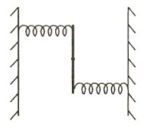
A uniform rod of length $L$ and mass $M$ is pivoted at the centre. Its two ends are attached to two springs of equal spring constants $k$. The springs are fixed to rigid supports as shown in the figure, and the rod is free to oscillate in the horizontal plane. The rod is gently pushed through a small angle $\theta$ in one direction and released. The frequency of oscillation is
IIT 2009, Diffcult
Download our app for free and get started
The correct option is $C \frac{1}{2 \pi}, \frac{\overline{6 k}}{ M }$
ANSWER:
Spring force acting at the end gives restoring torque
$\tau=r F \sin \theta$
$\Rightarrow \tau_0=-\left(k x \frac{L}{2} \cos \theta\right) \times 2$
Value of displacement of spring,
$x=\frac{L}{2} \sin \theta$
For the value of angular displacement tends to zero,
$\theta \rightarrow 0$
$\Rightarrow \cos \theta \cong 1, \sin \theta \cong \theta$
Then torque,
$\Rightarrow \tau=-k \frac{L}{2} \times \frac{L}{2} \theta=-\frac{k L^2}{2} \theta \ldots$
From equation $(i)$,
$\Rightarrow \tau=1 a=\frac{k L^2}{2} \theta$
$\Rightarrow \frac{M L^2}{12} a=-\frac{k L^2}{2} \theta$
$\Rightarrow a=-\frac{6 k}{M} \theta=-\omega^2 \theta$
$\Rightarrow \omega=\sqrt{\frac{6 k}{M}}$
Time period,
$T =\frac{2 \pi}{\omega}$
$\Rightarrow T=2 \pi \sqrt{\frac{M}{6 k}}$
Frequency,
$f=\frac{1}{T}=\frac{1}{2 \pi} \sqrt{\frac{\overline{M k}}{M}}$
Final answer: $(c)$

Download our appand get started for free
Experience the future of education. Simply download our apps or reach out to us for more information. Let's shape the future of learning together!No signup needed.*
Similar Questions
- 1Two pendulums have time periods $T$ and $5T/4.$ They start $SHM$ at the same time from the mean position. After how many oscillations of the smaller pendulum they will be again in the same phase :View Solution
- 2View SolutionTwo particles are oscillating along two close parallel straight lines side by side, with the same frequency and amplitudes. They pass each other, moving in opposite directions when their displacement is half of the amplitude. The mean positions of the two particles lie on a straight line perpendicular to the paths of the two particles. The phase difference is
- 3A block of mass m, attached to a spring of spring constant $k$, oscillates on a smooth horizontal table. The other end of the spring is fixed to a wall. The block has a speed $v$ when the spring is at its natural length. Before coming to an instantaneous rest, if the block moves a distance $x$ from the mean position, thenView Solution
- 4A $1.00 \times 10^{-20} \,kg$ particle is vibrating under simple harmonic motion with a period of $1.00 \times 10^{-5} \,s$ and with a maximum speed of $1.00 \times 10^3 \,m / s$. The maximum displacement of particle from mean position is .......... $mm$View Solution
- 5Function $x$ = $A sin^2 wt + B cos^2 wt + C sin wt \ cos wt$ does not represents $SHM$ for this conditionView Solution
- 6The amplitude of a wave represented by displacement equationView Solution
$y = \frac{1}{{\sqrt a }}\,\sin \,\omega t \pm \frac{1}{{\sqrt b }}\,\cos \,\omega t$ will be
- 7The length of a simple pendulum is increased by $1\%$. Its time period willView Solution
- 8A simple pendulum with a metallic bob has a time period $T$. The bob is now immersed in a non-viscous liquid and oscillated. If the density of the liquid is $1 / 4$ that of metal, the time period of the same pendulum will be ...........View Solution
- 9A cylindrical block of density $\rho$ is partially immersed in a liquid of density $3\rho .$ The plane surface of the block remains parallel to the surface of the liquid. The height of the block is $60\, cm.$ The block performs $SHM$ when displaced from its mean position. [Use $ g = 9.8\, m/s^2$]View Solution
- 10A mass $\mathrm{m}$ is suspended from a spring of negligible mass and the system oscillates with a frequency $f_1$. The frequency of oscillations if a mass $9 \mathrm{~m}$ is suspended from the same spring is $f_2$. The value of $\frac{f_1}{f_{.2}}$ is_____________.View Solution