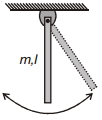
A uniform rod of mass $m$ and length $I$ is suspended about its end, Time period of small angular oscillations is ..........
Medium


Download our appand get started for free
Experience the future of education. Simply download our apps or reach out to us for more information. Let's shape the future of learning together!No signup needed.*
Similar Questions
- 1A particle is executing $SHM$ along a straight line. Its velocities at distance $x_1$ and $x_2$ from the mean position are $V_1$ and $V_2$ respectively. Its time period isView Solution
- 2A body oscillates with a simple harmonic motion having amplitude $0.05\, m .$ At a certain instant, its displacement is $0.01\, m$ and acceleration is $1.0 \,m / s ^{2} .$ The period of oscillation isView Solution
- 3A simple pendulum of length $l$ and mass $m$ of the bob is suspended in a car that is travelling with a constant speed $v$ around a circular path of radius $R$. If the pendulum undergoes oscillations with small amplitude about its equilibrium position, the frequency of its oscillations will beView Solution
- 4If the length of a clock pendulum increases by $0.2 \%$ due to atmospheric temperature rise, then the loss in time of clock per day is ........... $s$View Solution
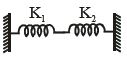
- 5View SolutionThe effective spring constant of two spring system as shown in figure will be
- 6The time period of a simple pendulum is $2\, sec$. If its length is increased $4$ times, then its period becomes ..... $\sec$View Solution
- 7The energy of a particle executing simple harmonic motion is given by $E = Ax^2 + Bv^2$, where $x$ is the displacement from mean position $x = 0$ and $v$ is the velocity of the particle at $x$ then choose the incorrect statementView Solution
- 8Which of the following expressions corresponds to simple harmonic motion along a straight line, where $x$ is the displacement and $a, b, c$ are positive constants?View Solution
- 9View SolutionTime period of pendulum, on a satellite orbiting the earth, is
- 10A simple pendulum is placed at a place where its distance from the earth's surface is equal to the radius of the earth. If the length of the string is $4 \mathrm{~m}$, then the time period of small oscillations will be ____ $s$. $\left[\right.$ take $\left.\mathrm{g}=\pi^2 \mathrm{~ms}^{-2}\right]$View Solution