MCQ
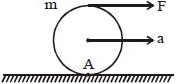
A uniform solid sphere of mass $m$ is being pulled on a horizontal surface with force $F$ parallel to the surface and applied at its top most point. If the acceleration of the cylinder is $a$ & it is rolling on the surface, the value of $F$ is 
  • A
    $ma$
  • B
    $\frac {3}{2}\ ma$
  • $\frac {7}{10}\ ma$
  • D
    $\frac {10}{7}\ ma$

Answer

Correct option: C.
$\frac {7}{10}\ ma$
c
Writting torque equation about an axis passing through $A,$ perpendicular to the plane of paper.

$\Rightarrow \mathrm{F} \times 2 \mathrm{R}=\left(\frac{2}{5} \mathrm{mR}^{2}+\mathrm{mR}^{2}\right) \times \infty$ $...(i)$

$\mathrm{a}=\mathrm{R} \propto$

$\Rightarrow \mathrm{F}=\frac{7}{10} \mathrm{ma}$

Need a full question paper?

Generate a complete, print-ready paper with questions like this in minutes — across 16+ boards, with answer keys.

Start Generating Free

Similar questions

The ratio of the radii of gyration of a circular disc to that of a circular ring, each of same mass and radius, around their respective axes is
A particle moves with simple harmonic motion in a straight line. In first $\tau  \,s$, after starting from rest, it travels a distance $a$, and in next $\tau \,s$, it travels $2a$ in same direction then
During an experiment, an ideal gas is found to obey a condition $VP^2 =$ constant. The gas is initially at a temperature $T$, pressure $P$ and volume $V.$ The gas expands to volume $4V$. 
The modulation frequency of an $AM$ radio station is $250\, kHz$, which is $10\%$ of the carrier wave. If another $AM$ station approaches you for license what broadcast frequency will you allot?........$kHz$
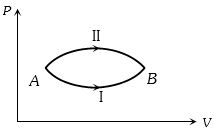
A system goes from $A$ to $B$ via two processes $I$ and $II$ as shown in figure. If $\Delta {U_1}$ and $\Delta {U_2}$ are the changes in internal energies in the processes $I$ and $II$ respectively, then
Magnifying power of a simple microscope is (when final image is formed at $D = 25\; cm$ from eye)
$Assertion :$ Doppler formula for sound wave is symmetric with respect to the speed of source and speed of observer.
$Reason :$ Motion of source with respect to stationary observer is not equivalent to the motion of an observer with respect to stationary source.
A cube of a metal is given a positive charge $Q$. For the above system, which of the following statements is true
Force acting on a particle moving in a straigth line varies with the velocity of the particle as $F =\frac {K}{v},$ where $K$ is a constant. The work done by this force in time $t$ is
In carbon monoxide molecules, the carbon and the oxygen atoms are separated by distance $1.2 \,\mathring A$. The distance of the centre of mass, from the carbon atom is ........  $\mathring A$