Question
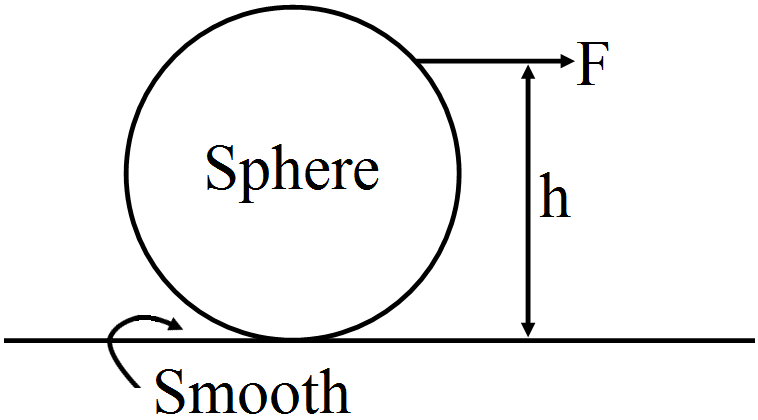
A uniform sphere is placed on a smooth horizontal surface and a horizontal force F is applied on it at a distance h above the surface. The acceleration of the centre:
  1. Is maximum when h = 0.
  2. Is maximum when h = R.
  3. Is maximum when h = 2R.
  4. Is independent of h.

Answer

  1. Is independent of h.

Explanation:

As the uniform sphere is placed on a smooth surface, the sphere only slips.

The acceleration of the centre of the sphere is given by,

$\frac{\text{Applied force}}{\text{Mass of the sphere}},$ which is independent of height h.

Need a full question paper?

Generate a complete, print-ready paper with questions like this in minutes — across 16+ boards, with answer keys.

Start Generating Free

Similar questions

Which one of the following statements is not true about the motion of a projectile?
Two simple harmonic motions are represented by the equations

${x}_{1}=5 \sin \left(2 \pi {t}+\frac{\pi}{4}\right)$ and ${x}_{2}=5 \sqrt{2}(\sin 2 \pi {t}+\cos 2 \pi {t})$

The amplitude of second motion is ....... times the amplitude in first motion.

One mole of monoatomic gas and three moles of diatomic gas are put together in a container. The molar specific heat (in $J\,{K^{ - 1}}\,mo{l^{ - 1}})$ at constant volume is $(R = 8.3\,J\,{K^{ - 1}}\,mo{l^{ - 1}})$
A wave is reflected from a rigid support. The change in phase on reflection will be
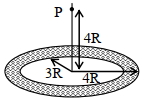
A thin uniform annular disc (see figure) of mass $M$ has outer radius $4 R$ and inner radius $3 R$. The work required to take a unit mass from point $P$ on its axis to infinity is
Two particles of identical mass are moving in circular orbits under a potential given by $V(r)=K r^{-n}$, where $K$ is a constant. If the radii of their orbits are $r_1 \cdot r_2$ and their speeds are $v_1 \cdot v_2$, respectively. Then,
  Consider the following statements.
  1. The coefficient of linear expansion has dimension K-1.
  2. The coefficient of volume expansion has dimension K-1.
  1. A and B are correct.
  2. A is correct but B is wrong.
  3. B is correct but A is wrong.
  4. A and B both wrong.
A student of mass $M$ is $1.5 \,m$ tall and has her centre of mass $1 \,m$ above ground when standing straight. She wants to jump up vertically. To do so. she bends her knees so that her centre of mass is lowered by $0.2 \,m$ and then pushes the ground by a constant force F. As a result, she jumps up such that the maximum height of her feet is $0.3 \,m$ above ground. The ratio $F / Mg$ is
According to Newton, the viscous force acting between liquid layers of area $A$ and velocity gradient $\Delta v/\Delta z$ is given by $F = - \eta A\frac{{\Delta v}}{{\Delta z}}$ where $\eta $ is constant called coefficient of viscosity. The dimension of $\eta $ are
A body is projected horizontally from the top of a tower with initial velocity $18\,m s^{-1}$. It hits the ground at angle $45^o$. What is the vertical component of velocity when it strikes the ground ......... $ms^{-1}$