Question
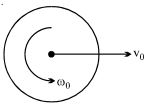
$A$ uniform sphere of radius $R$ is placed on $a$ rough horizontal surface and given a linear velocity $v_0$ angular velocity $\omega_0$ as shown. The sphere comes to rest after moving some distance to the right. It follows that:
Answer

Get the step-by-step solution for this question inside the Vidyadip app.

Get the answer in the app

Need a full question paper?

Generate a complete, print-ready paper with questions like this in minutes — across 16+ boards, with answer keys.

Start Generating Free

Similar questions

When a metal surface is illuminated by light of wavelength $\lambda$, the stopping potential is $8 \mathrm{~V}$. When the same surface is illuminated by light of wavelength $3 \lambda$, stopping potential is $2 \mathrm{~V}$. The threshold wavelength for this surface is :
This question has Statement $1$ and Statement $2.$ Of the four choices given after the Statements, choose the one that best describes the two Statements.

Statement $1:$ A metallic surface is irradiated by a monochromatic light of frequency $v > v_0$ (the threshold frequency). If the incident frequency is now doubled, the photocurrent and the maximum kinetic energy are also doubled.

Statement $2:$ The maximum kinetic energy of photoelectrons emitted from a surface is linearly dependent on the frequency of the incident light. The photocurrent depends only on the intensity of the incident light.
In a capillary rise experiment, the water level rises to a height of $5\, cm$. If the same capillary tube is placed in water such that only $3\, cm$ of the tube projects outside the water level, then
The concept of stationary orbits was proposed by
The amount of energy required to form a soap bubble of radius $2\,cm$ from a soap solution is nearly $..........\,\times 10^{-4}\,J$: (surface tension of soap solution $=0.03\,N\,m ^{-1}$ )
A bar magnet is oscillating in the Earth’s magnetic field with a period $T$. What happens to its period and motion if its mass is quadrupled
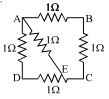
$ABCD$ is a square where each side is a uniform wire of resistance $1\,\Omega$ . $A$ point $E$ lies on $CD$ such that if a uniform wire of resistance $1\,\Omega$ is connected across $AE$ and constant potential difference is applied across $A$ and $C$ then $B$ and $E$ are equipotential.
For a planet having mass equal to mass of the earth but radius is one fourth of radius of the earth. Then escape velocity for this planet will be
Which one of the following statements is not true about the motion of a projectile?
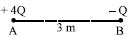
Two fixed charges $4\,Q$ (positive) and $Q$ (negative) are located at $A$ and $B$, the distance $AB$ being $3$ $m$.