MCQ
A uniform spherical planet (Radius $R$) has acceleration due to gravity at its surface $g.$ Points $P$ and $Q$ located inside and outside the planet have acceleration due to gravity $\frac{g}{4} .$ Maximum possible separation between $P$ and $Q$ is
  • A
    $\frac{{7R}}{4}$
  • B
    $\frac{{3R}}{4}$
  • $\frac{{9R}}{4}$
  • D
    none

Answer

Correct option: C.
$\frac{{9R}}{4}$
c
variation with depth

$g_{d}=g(1-d / R)$

$\frac{g}{4}=g(1-d / R)$

$\frac{d}{R}=3 / 4$

$a=3 R / 4$

variation with height

$g_{h}=g\left(1-\frac{2 h}{R}\right)$

$\frac{g}{4}=g\left(1-\frac{2 h}{R}\right)$

$\frac{2 h}{R}=\frac{3}{4}$

$h=\frac{3 R}{8}$

max distance $=a+h=\frac{3 R}{4}+\frac{3 R}{8}$

$=\frac{9 R}{8}$

Need a full question paper?

Generate a complete, print-ready paper with questions like this in minutes — across 16+ boards, with answer keys.

Start Generating Free

Similar questions

A Carnot engine absorbs $1000\,J$ of heat energy from a reservoir at $127\,^oC$ and rejects $600\,J$ of heat energy during each cycle. The efficiency of engine and temperature of sink will be
Dimensions of pair are same. Identify the pair
A spring is stretched by applying a load to its free end. The strain produced in the spring is
What is the value of acceleration caused by force of gravity on a stone placed on ground?
Column $I$ describe some situations in which a small object moves. Column $II$ describes some characteristics of these motions. Match the situation in Column $I$ with the characteristics in Column $II$ and indicate your answer by darkening appropriate bubbles in the $4 \times 4$ matrix given in the $ORS$.
Column $I$ Column $II$
$(A)$ The object moves on the $\mathrm{x}$-axis under a conservative force in such a way that its "speed" and "position" satisfy $v=c_1 \sqrt{c_2-x^2}$, where $\mathrm{c}_1$ and $\mathrm{c}_2$ are positive constants. $(p)$ The object executes a simple harmonic motion.
$(B)$ The object moves on the $\mathrm{x}$-axis in such a way that its velocity and its displacement from the origin satisfy $\mathrm{v}=-\mathrm{kx}$, where $\mathrm{k}$ is a positive constant. $(q)$ The object does not change its direction.
$(C)$ The object is attached to one end of a massless spring of a given spring constant. The other end of the spring is attached to the ceiling of an elevator. Initially everything is at rest. The elevator starts going upwards with a constant acceleration a. The motion of the object is observed from the elevator during the period it maintains this acceleration. $(r)$ The kinetic energy of the object keeps on decreasing.
$(D)$ The object is projected from the earth's surface vertically upwards with a speed $2 \sqrt{\mathrm{GM}_e / R_e}$, where, $M_e$ is the mass of the earth and $R_e$ is the radius of the earth. Neglect forces from objects other than the earth. $(s)$ The object can change its direction only once.
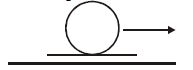
A ball rests upon a flat piece of paper on a table top. The paper is pulled horizontally but quickly towards right as shown. Relative to its initial position with respect to the table, the ball

$(A)$ Remains stationary if there no friction between the paper and the ball

$(B)$ Moves to the left and starts rolling backwards, $i.e.$, to the left if there is a friction between the paper and the ball

$(C)$ Moves foward, $i.e.$ in the direciton in 'which the paper is pulled

Here, the correct statements is/are

$Assertion :$ When a beetle moves along the sand within a few tens of centimeters of a sand scorpion, the scorpion immediately turns towards the beetle and dashes towards it
$Reason :$ When a beetle disturbs the sand, it sends pulses along the sand's surface. One set of pulses is longitudinal while the other set is transverse.
Two projectiles of same mass and with same velocity are thrown at an angle $60^o$ and $30^o$ with the horizontal, then which quantity will remain same
Let $\gamma_1$ be the ratio of molar specific heat at constant pressure and molar specific heat at constant volume of a monoatomic gas and $\gamma_2$ be the similar ratio of diatomic gas. Considering the diatomic gas molecule as a rigid rotator, the ratio, $\frac{\gamma_1}{\gamma_2}$ is
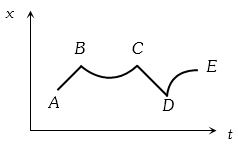
Figure shows the displacement of a particle going along the $X-$axis as a function of time. The force acting on the particle is zero in the region