MCQ
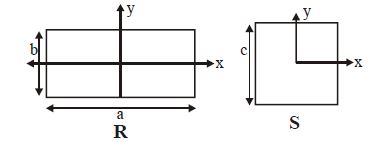
A uniform square plate $S$ (side $c$) and a uniform rectangular plate $R$ (sides $b$, $a$) ($a > b$) have identical areas and masses figure. Which of the following is correct

$(a)\ I_{xR}/I_{xS} <1;\  (b)\ I_{yR}/I_{yS}  >1; \  (c)\ I_{zR}/I_{zS} >1$
  • A
    $a$,$b$
  • B
    $b$,$c$
  • $a$,$b$,$c$
  • D
    None

Answer

Correct option: C.
$a$,$b$,$c$
c
$a b=c^{2}$           $a>c>b$

$\mathrm{I}_{\mathrm{XR}}=\frac{\mathrm{Mb}^{2}}{12}, \mathrm{I}_{\mathrm{YR}}=\frac{\mathrm{Ma}^{2}}{12}, \mathrm{I}_{\mathrm{ZR}}=\frac{\mathrm{M}\left(\mathrm{a}^{2}+\mathrm{b}^{2}\right)}{12}$

$\mathrm{I}_{\mathrm{XS}}=\frac{\mathrm{Mc}^{2}}{12}, \mathrm{I}_{\mathrm{YS}}=\frac{\mathrm{Mc}^{2}}{12}, \mathrm{I}_{\mathrm{zs}}=\frac{\mathrm{Mc}^{2}}{6}$

$\frac{\mathrm{I}_{\mathrm{ZR}}}{\mathrm{I}_{\mathrm{ZS}}}=\frac{1}{2}\left(\left(\frac{\mathrm{a}}{\mathrm{c}}\right)^{2}+\left(\frac{\mathrm{b}}{\mathrm{c}}\right)^{2}\right)$

$=\frac{1}{2}\left(\left(\frac{\mathrm{a}}{\mathrm{c}}\right)^{2}+\left(\frac{\mathrm{c}}{\mathrm{a}}\right)^{2}\right)$

$\frac{I_{\mathbb{Z R}}}{I_{Z S}}>1$

$x+\frac{1}{x}>2$ if $x>0$

Need a full question paper?

Generate a complete, print-ready paper with questions like this in minutes — across 16+ boards, with answer keys.

Start Generating Free

Similar questions

Two waves are represented by the equations ${y_1} = a\sin \omega t$ and ${y_2} = a\cos \omega t.$ The first wave
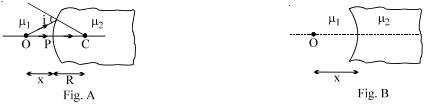
$A$ curved surface of radius $R$ separates two medium of refractive indices $\mu_1$ and $\mu_2$ as shown in figures $A$ and $B$ Identify the correct statement $(s)$ related to the formation of images of a real object $O$ placed at $x$ from the pole of the concave surface, as shown in figure $B$
A particle starts moving rectilinearly at time $t = 0$ such that its velocity $'v'$ changes with time $'t'$ according to the equation $v = t^2 - t$ where $t$ is in seconds and $v$ is in $m/s.$ The time interval for which the particle retards is
A charged capacitor discharges through a resistance $R$ with time constant $\tau$. The two are now placed in series across an $AC$ source of angular frequeny $\omega = \frac{1}{\tau }$ The impedance of the circuit will be-
The driver of a bus approaching a big wall notices that the frequency of his bus's horn changes from $420\, Hz$ to $490\, Hz ,$ when he hears it after it gets reflected from the wall. Find the speed of the bus (in $kmh^{-1}$) if speed of the sound is $330\, ms ^{-1}$.
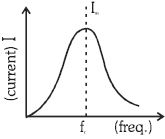
The graph shows variation of $I$ with $f$ for a series $R-L-C$ network. Keeping $L$ and $C$ constant. If $R$ decreases

$(a)$ Maximum current $(I_m)$ increases
$(b)$ Sharpness of the graph increases
$(c)$ Quality factor increases
$(d)$ Band width increases

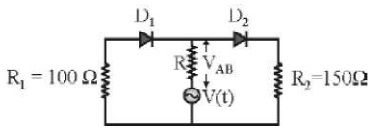
In the circuit given below, $V ( t )$ is the sinusoidal voltage source, voltage drop $V_{A B}(t)$ across the resistance $R$ is
The nuclear activity of a radioactive element becomes $\left(\frac{1}{8}\right)^{\text {th }}$ of its initial value in $30\, years.$ The half-life of radioactive element is $....\,years.$
What is minimum length of a tube, open at both ends, that resonates with tuning fork of frequency $350 Hz$ ? [velocity of sound in air $= 350 m/s$]  ..... $cm$
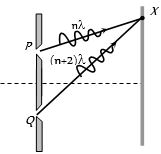
The figure shows a double slit experiment $P$ and $Q$ are the slits. The path lengths $PX $ and $ QX $ are $n\lambda $ and $(n + 2)\lambda $ respectively, where $n $ is a whole number and $\lambda $ is the wavelength. Taking the central fringe as zero, what is formed at $X$