MCQ
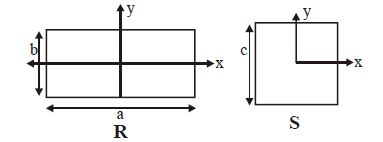
A uniform square plate $S$ (side $c$) and a uniform rectangular plate $R$ (sides $b$, $a$) ($a > b$) have identical areas and masses figure. Which of the following is correct

$(a)\ I_{xR}/I_{xS} <1;\  (b)\ I_{yR}/I_{yS}  >1; \  (c)\ I_{zR}/I_{zS} >1$
  • A
    $a$,$b$
  • B
    $b$,$c$
  • $a$,$b$,$c$
  • D
    None

Answer

Correct option: C.
$a$,$b$,$c$
c
$a b=c^{2}$           $a>c>b$

$\mathrm{I}_{\mathrm{XR}}=\frac{\mathrm{Mb}^{2}}{12}, \mathrm{I}_{\mathrm{YR}}=\frac{\mathrm{Ma}^{2}}{12}, \mathrm{I}_{\mathrm{ZR}}=\frac{\mathrm{M}\left(\mathrm{a}^{2}+\mathrm{b}^{2}\right)}{12}$

$\mathrm{I}_{\mathrm{XS}}=\frac{\mathrm{Mc}^{2}}{12}, \mathrm{I}_{\mathrm{YS}}=\frac{\mathrm{Mc}^{2}}{12}, \mathrm{I}_{\mathrm{zs}}=\frac{\mathrm{Mc}^{2}}{6}$

$\frac{\mathrm{I}_{\mathrm{ZR}}}{\mathrm{I}_{\mathrm{ZS}}}=\frac{1}{2}\left(\left(\frac{\mathrm{a}}{\mathrm{c}}\right)^{2}+\left(\frac{\mathrm{b}}{\mathrm{c}}\right)^{2}\right)$

$=\frac{1}{2}\left(\left(\frac{\mathrm{a}}{\mathrm{c}}\right)^{2}+\left(\frac{\mathrm{c}}{\mathrm{a}}\right)^{2}\right)$

$\frac{I_{\mathbb{Z R}}}{I_{Z S}}>1$

$x+\frac{1}{x}>2$ if $x>0$

Need a full question paper?

Generate a complete, print-ready paper with questions like this in minutes — across 16+ boards, with answer keys.

Start Generating Free

Similar questions

      Column $-I$

    Angle of projection

    Column $-II$
  $A.$ $\theta \, = \,{45^o}$   $1.$ $\frac{{{K_h}}}{{{K_i}}} = \frac{1}{4}$
  $B.$ $\theta \, = \,{60^o}$   $2.$ $\frac{{g{T^2}}}{R} = 8$
  $C.$ $\theta \, = \,{30^o}$   $3.$ $\frac{R}{H} = 4\sqrt 3 $
  $D.$ $\theta \, = \,{\tan ^{ - 1}}\,4$   $4.$ $\frac{R}{H} = 4$

$K_i :$ initial kinetic energy

$K_h :$ kinetic energy at the highest point

A mass $m$ hangs with the help of a string wrapped around a pulley on a firctionless  bearing. The pulley has mass $m$ and radius $R$. Assuming pulley to be a perfect  uniform circular disc, the acceleration of the mass $m$, if the string does not slip on the  pulley, is:-
$3$ particles each of mass $m$ are kept at vertices of an equilateral triangle of side $L$. The gravitational field at centre due to these particles is
A boy playing on the roof of a $10\, m$ high building throws a ball with a speed of $10\, m/s$ at an angle $30^o$ with the horizontal. ........ $m$ far from the throwing point will the ball be at the height of $10\, m$ from the ground . $(g \,= \,10 m/s^2, \,sin \,30^o \,= \,\frac{1}{2}$, $\cos \,{30^o}\, = \,\frac{{\sqrt 3 }}{2}$)
A hot solid sphere is rotating about a diameter at an angular velocity $\omega_0$. If it cools so that its radius reduces to $\frac{1}{\eta}$ of its original value, its angular velocity becomes .............
Two projectiles are thrown simultaneously in the same plane from the same point. If their velocities are $v_1$ and $v_2$ at angles $\theta _1$ and $\theta_2$ respectively from the horizontal, then answer the following question

If $v_1 = v_2$ and $\theta _1 > \theta _2$, then choose the incorrect statement

Temperature of water at the surface of lake is $ - {20^o}C$ Then temperature of water just below the lower surface of ice layer is ...... $^oC$
A stone of mass $150\ g$ moves in a vertical circle on the end of a length of string. The radius of the cirlce is $70\ cm$ and the speed of the stone at the topmost point $P$ is $3.5\ m/s$ . For the instant at which the stone passes through the highest point $P$ , the centripetal force is nearly    ......... $N$ (take $g = 10\ m/s^2$ )
A body is moving in a low circular orbit about a planet of mass $M$ and radius $R$. The radius of the orbit can be taken to be $R$ it self. Then the ratio of the speed of this body in the orbit to the escape velocity from the planet is
A closed cubical box is completely filled with water and is accelerated horizontally towards right with an acceleration α. The resultant normal force by the water on the top of the box.
  1. Passes through the centre of the top.
  2. Passes through a point to the right of the centre.
  3. Passes through a point to the left of the centre.
  4. Pecomes zeros.