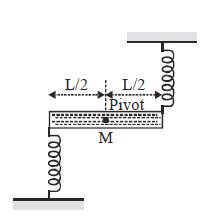
A uniform stick of mass $M$ and length $L$ is pivoted at its centre. Its ends are tied to two springs each of force constant $K$ . In the position shown in figure, the strings are in their natural length. When the stick is displaced through a small angle $\theta $ and released. The stick
Advanced
Download our app for free and get started
If stick is rotated through a small angle $\theta,$ the
spring is stretched by a distance $\frac{\mathrm{L}}{2} \theta .$ Therefore
restoring force is spring $=\mathrm{K}\left(\frac{\mathrm{L}}{2} \theta\right) .$ Each spring
causes a torque $\tau(=\mathrm{Fd})=\left(\frac{\mathrm{KL} \theta}{2}\right) \frac{\mathrm{L}}{2}$ in the
same direction.
Therefore equation of ratational motion is $\tau=I \alpha$
$-2\left(\frac{\mathrm{KL} \theta}{2}\right) \frac{\mathrm{L}}{2}=\mathrm{I} \alpha$ with $\mathrm{I}=\frac{\mathrm{ML}^{2}}{12}$
$\alpha=-\left(\frac{6 K}{M}\right) \theta$
Standard equation of angular $S.H.M.$ is
$\alpha=-\omega^{2} \theta$
$\omega^{2}=\frac{6 \mathrm{K}}{\mathrm{M}}$
frequency $\quad \mathrm{f}=\frac{\omega}{2 \pi}=\frac{1}{2 \pi} \sqrt{\frac{6 \mathrm{K}}{\mathrm{M}}}$

Download our appand get started for free
Experience the future of education. Simply download our apps or reach out to us for more information. Let's shape the future of learning together!No signup needed.*
Similar Questions
- 1Two springs of constant ${k_1}$and ${k_2}$are joined in series. The effective spring constant of the combination is given byView Solution
- 2Length of a simple pendulum is $l$ and its maximum angular displacement is $\theta$, then its maximum $K.E.$ isView Solution
- 3View SolutionThe total energy of a particle executing simple harmonic motion is
- 4If a simple pendulum is taken to place where g decreases by $2\%$, then the time periodView Solution
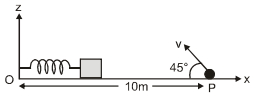
- 5A small block is connected to one end of a massless spring of un-stretched length $4.9 \ m$. The other end of the spring (see the figure) is fixed. The system lies on a horizontal frictionless surface. The block is stretched by $0.2$ $m$ and released from rest at $t =0$. It then executes simple harmonic motion with angular frequency $\omega=\frac{\pi}{3} \ rad / s$.View Solution
Simultaneously at $t=0$, a small pebble is projected with speed $v$ from point $P$ at an angle of $45^{\circ}$ as shown in the figure. Point $P$ is at a horizontal distance of $10 \ cm$ from $O$. If the pebble hits the block at $t=1 \ s$, the value of $v$ is (take $g =10 \ m / s ^2$ )
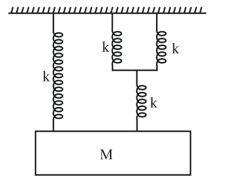
- 6The time period of simple harmonic motion of mass $\mathrm{M}$ in the given figure is $\pi \sqrt{\frac{\alpha M}{5 K}}$, where the value of $\alpha$ is____.View Solution
- 7A simple pendulum suspended from the ceiling of a stationary lift has period $T_0$. When the lift descends at steady speed, the period is $T_1$, and when it descends with constant downward acceleration, the period is $T_2$. Which one of the following is true?View Solution
- 8Let $T_1$ and $T_2$ be the time periods of two springs $A$ and $B$ when a mass $m$ is suspended from them separately. Now both the springs are connected in parallel and same mass $m$ is suspended with them. Now let $T$ be the time period in this position. ThenView Solution
- 9Time period of a simple pendulum in a stationary lift is ' $T$ '. If the lift accelerates with $\frac{ g }{6}$ vertically upwards then the time period will be .....View Solution
(where $g =$ acceleration due to gravity)
- 10The length of the second pendulum on the surface of earth is $1\, m$. The length of seconds pendulum on the surface of moon, where g is 1/6th value of $g$ on the surface of earth, isView Solution