MCQ
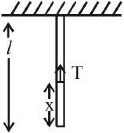
A uniform string oflength $20\ m$ is suspended from a rigid support. A short wave pulse is introduced at its lowest end. It starts moving up the string. The time taken to reach the supports is (take $g= 10 $ $ms^{-2}$ )
  • $2$$\sqrt 2 s$
  • B
    $\sqrt 2 s$
  • C
    $\;2\pi \sqrt 2 s$
  • D
    $2s$

Answer

Correct option: A.
$2$$\sqrt 2 s$
a
We know that velocity in string is given by

$\mathrm{v}=\sqrt{\frac{\mathrm{T}}{\mu}}$              $...(I)$

where $\mu=\frac{\mathrm{m}}{1}=\frac{\text { mass of string }}{\text { length of string }}$

The tension $\mathrm{T}=\frac{\mathrm{m}}{\ell} \times \mathrm{x} \times \mathrm{g}$                   $...(II)$

From $(a)$ and $(b)$

$\frac{d x}{d t}=\sqrt{g x}$

$\mathrm{x}^{-1 / 2} \mathrm{dx}=\sqrt{\mathrm{g}} \mathrm{dt} \quad \therefore \int_{0}^{\ell} \mathrm{x}^{-1 / 2} \mathrm{dx}-\sqrt{\mathrm{g}} \int_{0}^{\ell} \mathrm{dt}$

$2 \sqrt{l}=\sqrt{g} \times t \quad \therefore t=2 \sqrt{\frac{\ell}{g}}=2 \sqrt{\frac{20}{10}}=2 \sqrt{2}$

Need a full question paper?

Generate a complete, print-ready paper with questions like this in minutes — across 16+ boards, with answer keys.

Start Generating Free

Similar questions

The axis of rotation of a purely rotating body:
  1. Must pass through the centre of mass.
  2. May pass through the centre of mass.
  3. Must pass through a particle of the body.
  4. May pass through a particle of the body.
Different processes are given in Column - $\mathrm{I}$ and its reasons are given in Column - $\mathrm{II}$. Match the appropriately.
Column - $\mathrm{I}$ Column - $\mathrm{II}$
$(a)$Rain drops moves downwards with constant velocity. $(i)$ Viscous liquids
$(b)$ Floating clouds at a height in air. $(ii)$ Viscosity
    $(iiii)$ Less density
How many wavelength of $K{r^{86}}$ are there in one metre
The temperature of $5$ moles of a gas which was held at constant volume was changed from ${100^o}C$ to ${120^o}C$. The change in internal energy was found to be $80$ Joules. The total heat capacity of the gas at constant volume will be equal to ...... $J/K$
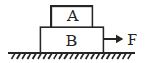
In figure, the coefficient of friction between the floor and the block $B$ is $0.1$. The coefficient of friction between the blocks $B$ and $A$ is $0.2$. The mass of $A$ is $\frac{m}{2}$  and of $B$ is $m$. ........ $mg$  is the maximum horizontal force $F$ can be applied to the block $B$ so that two blocks move together ?
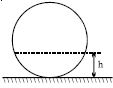
A liquid is filled in a spherical container of radius $R$ till a height $h$.At this positions the liquid surface at the edges is also horizontal. The contact angle is 
A thin uniform circular ring is rolling down an inclined plane of inclination $30^o $ without slipping. Its linear acceleration along the inclined plane will be
The change in the value of acceleration of earth towards sun, when the moon comes from the position of solar eclipse to the position on the other side of earth in line with sun is: (mass of the moon $= 7.36 \times 10^{22}\,kg,$ radius of the moon's orbit $= 3 .8 \times 10^8\,m$ ).
Two satellites $A$ and $B$ go round a planet in circular orbits having radii $4R$ and $R$, respectively. If the speed of satellite $A$ is $3v$, then speed of satellite $B$ is
A table tennis ball has radius $(3 / 2) \times 10^{-2} m$ and mass $(22 / 7) \times 10^{-3} kg$. It is slowly pushed down into a swimming pool to a depth of $d=0.7 m$ below the water surface and then released from rest. It emerges from the water surface at speed $v$, without getting wet, and rises up to a height $H$. Which of the following option(s) is (are) correct?

[Given: $\pi=22 / 7, g=10 ms ^{-2}$, density of water $=1 \times 10^3 kg m ^{-3}$, viscosity of water $=1 \times 10^{-3} Pa$-s.]

$(A)$ The work done in pushing the ball to the depth $d$ is $0.077 J$.

$(B)$ If we neglect the viscous force in water, then the speed $v=7 m / s$.

$(C)$ If we neglect the viscous force in water, then the height $H=1.4 m$.

$(D)$ The ratio of the magnitudes of the net force excluding the viscous force to the maximum viscous force in water is $500 / 9$.