Question
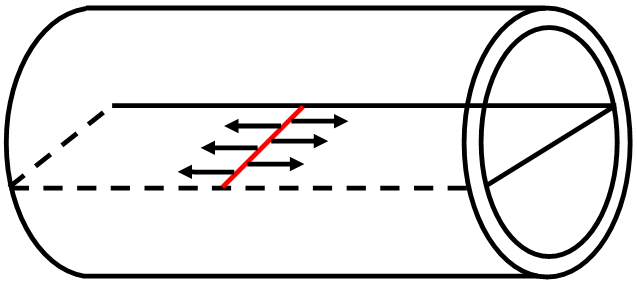
A uniform vertical tube of circular cross-section contains a liquid. The contact angle is $90^º$. Consider a diameter of the tube lying in the surface of the liquid. The surface to the right of this diameter pulls the surface on the left of it. What keeps the surface on the left in equilibrium?
Answer

As the angle of contact is 0, there is no force between the surface of the tube and the liquid. The diameter of the liquid surface is pulled on both sides by equal and opposite forces of surface tension. This results in no net force remaining on the surface of the liquid. Hence, the liquid stays in equilibrium.

Need a full question paper?

Generate a complete, print-ready paper with questions like this in minutes — across 16+ boards, with answer keys.

Start Generating Free

Similar questions

Temperature in the freezer of a refrigerator is being maintained at $-13^\circ C$ and room temperature on a particular day was $42^\circ C$. Calculate the coefficient of performance of the refrigerator.
In which of the following examples of motion, can the body be considered approximately a point object: A spinning cricket ball that turns sharply on hitting the ground.
Is stress a vector quantity?
It is said that a liquid rises or is depressed in a capillary due to the surface tension. If a liquid neither rises nor depresses in a capillary, can we conclude that the surface tension of the liquid is zero?
The maximum acceleration of a simple harmonic oscillator is $\text{a}_0$ and the maximum velocity is $\text{v}_0$. What is the displacement amplitude?
Answer the following: A screw gauge has a pitch of 1.0mm and 200 divisions on the circular scale. Do you think it is possible to increase the accuracy of the screw gauge arbitrarily by increasing the number of divisions on the circular scale ?
How does Bernoulli's principle help in understanding the flow of blood in vein?
Find the angle between force $F =(3 \hat{ i }+4 \hat{ j }-5 \hat{ k })$ unit and displacement $d =(5 \hat{ i }+4 \hat{ j }+3 \hat{ k })$ unit. Also find the projection of $F$ on $d$.
An electric bulb marked 220V, 100W will get fused if it is made to consume 150W or more. What voltage fluctuation will the bulb withstand?
A spherical planet has mass $M _{ P }$ and diameter $D _{ P }$. A particle of mass $m$ falling freely near the surface of this planet will experience acceleration due to gravity, equal to whom?