MCQ
A unit vector $a$  makes an angle $\frac{\pi }{4}$ with $z-$ axis. If $a + i + j$ is a  unit vector, then $a$  is equal to
  • A
    $\frac{i}{2} + \frac{j}{2} + \frac{k}{{\sqrt 2 }}$
  • B
    $\frac{i}{2} + \frac{j}{2} - \frac{k}{{\sqrt 2 }}$
  • $ - \frac{i}{2} - \frac{j}{2} + \frac{k}{{\sqrt 2 }}$
  • D
    None of these

Answer

Correct option: C.
$ - \frac{i}{2} - \frac{j}{2} + \frac{k}{{\sqrt 2 }}$
c
(c) Let $a = li + mj + nk,$ where ${l^2} + {m^2} + {n^2} = 1.$

a makes an angle $\frac{\pi }{4}$ with $z - $axis.

$\therefore \,\,n = \frac{1}{{\sqrt 2 }},$ ${l^2} + {m^2} = \frac{1}{2}$ …..$(i)$

$\therefore \,\,a = l\,i + m\,j + \frac{k}{{\sqrt 2 }}$

$a + i + j = (l + 1)i + (m + 1)j + \frac{k}{{\sqrt 2 }}$

Its magnitude is $1,$ hence ${(l + 1)^2} + {(m + 1)^2} = \frac{1}{2}$ .....$(ii)$

From $(i)$ and $(ii),$ $2lm = \frac{1}{2} \Rightarrow l = m = - \frac{1}{2}$

Hence $a = - \frac{i}{2} - \frac{j}{2} + \frac{k}{{\sqrt 2 }}$.

Need a full question paper?

Generate a complete, print-ready paper with questions like this in minutes — across 16+ boards, with answer keys.

Start Generating Free

Similar questions

The distance s metre covered by a body in $t$ seconds is given by $s = 3{t^2} - 8t + 5,$ the body will stop after
Which of the following inequalities is/are $TRUE$?

$(A)$ $\int_0^1 x \cos x d x \geq \frac{3}{8}$   $(B)$ $\int_0^1 x \sin x d x \geq \frac{3}{10}$  $(C)$ $\int_0^1 x^2 \cos x d x \geq \frac{1}{2}$  $(D)$ $\int_0^1 x^2 \sin x d x \geq \frac{2}{9}$

If $\text{f(x)}=\frac{1-\sin\text{x}}{(\pi-2\text{x})^2},$ when $\text{x}\neq\frac{\pi}{2}=\lambda$ then f(x) will be continuous function at $\text{x}=\frac{\pi}{2},$ where $\lambda=$
  1. $\frac{1}{8}$
  2. $\frac{1}{4}$
  3. $\frac{1}{2}$
  4. none of these
The area bounded by the $x$-axis, the curve $y=f(x)$ and the lines $x=1, x=b$ is equal to $\sqrt{b^2+1}-\sqrt{2}$ for all $b>1$. Which of the following can be $f(x)$ ?
If the area (in $sq. units$) of the region $\left\{ {\left( {x,y} \right):{y^2} \le 4x,x + y \le 1,x \ge 0,y \ge 0} \right\}$ is $a\sqrt 2  + b$, then $a -b$ is equal to
If $\text{A}=\begin{bmatrix}2&0&-3\\4&3&1\\-5&7&2\end{bmatrix}$ is expressed as the sum of a symmetric and skew-symmetric matrix, then the symmetric matrix is:
  1. $\begin{bmatrix}2&2&-4\\2&3&4\\-4&4&2\end{bmatrix}$
  2. $\begin{bmatrix}2&4&-5\\0&3&7\\-3&1&2\end{bmatrix}$
  3. $\begin{bmatrix}4&4&-8\\4&6&8\\-8&8&4\end{bmatrix}$
  4. $\begin{bmatrix}1&0&0\\0&1&0\\0&0&1\end{bmatrix}$
Using determinants, find the area (in sq. units) of triangle with vertices $(-3,5),(3,-6)$ and $(7,2)$.
If one pair of two unbiased dice are rolled then what is the probability of getting sum 5 ?
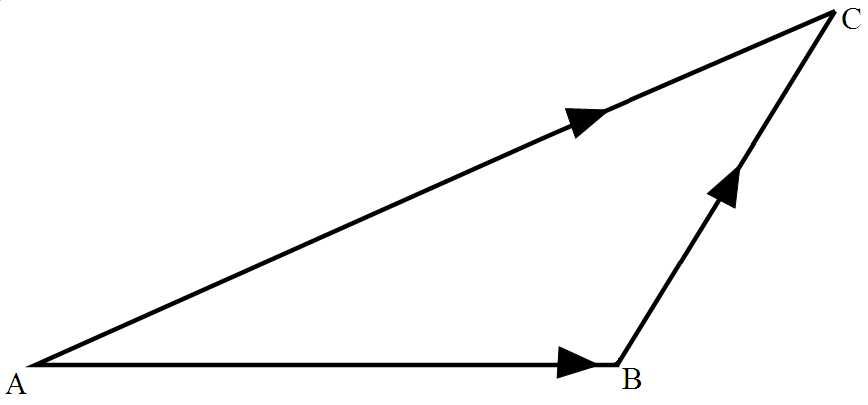
In figure, which of the following is not true?

  1. $​​​​​\overrightarrow{\text{AB}}+\overrightarrow{\text{BC}}+\overrightarrow{\text{CA}}=\vec0$

  2. $​​​​​\overrightarrow{\text{AB}}+\overrightarrow{\text{BC}}-\overrightarrow{\text{AC}}=\vec0$

  3. $​​​​​\overrightarrow{\text{AB}}+\overrightarrow{\text{BC}}-\overrightarrow{\text{CA}}=\vec0$

  4. $​​​​​\overrightarrow{\text{AB}}-\overrightarrow{\text{CB}}+\overrightarrow{\text{CA}}=\vec0$

Let R be the relation in the set N given by $R =\{(a, b): a=b-2, b>6\}$. Then choose the correct option from the following.