Question
A unitless quantity:
  1. Never has a non-zero dimension.
  2. Always has a non-zero dimension.
  3. May have a non-zero dimension.
  4. Does not exist.

Answer

  1. Never has a non-zero dimension.

Explanation:

A unitless quantity never has a non-zero dimension.

Need a full question paper?

Generate a complete, print-ready paper with questions like this in minutes — across 16+ boards, with answer keys.

Start Generating Free

Similar questions

Energy of electrons can be increased by allowing them

(a) To fall through electric potential

(b) To move in high magnetic field

(c) To fall from great heights

(d) To pass through lead blocks

Why high temperature is required for Nuclear fusion?
The correct equation of nuclear fusion reaction is:

A symmetric double convex lens is cut in two equal parts by a plane perpendicular to the principal axis. If the power of the original lens was 4D, the power of a cutlens will be:

When a drop of oil is spread on a water surface, it displays beautiful colors in daylight because of:

In a PN-junction diode not connected to any circuit

(a) The potential is the same everywhere

(b) The P-type is a higher potential than the N-type side

(c) There is an electric field at the junction directed from the N- type side to the P- type side

(d) There is an electric field at the junction directed from the P-type side to the N-type side

A magician during a show makes a glass lens with refractive index $n = 1.5$ disappear in a trough of liquid. The refractive index of liquid $=$ __________ .

Dual nature of radiation is shown by

(a) Diffraction and reflection

(b) Refraction and diffraction

(c) Photoelectric effect alone

(d) Photoelectric effect and diffraction

Two resistors are connected (a) in series (b) in parallel. The equivalent resistance in the two cases are 9 ohm and 2 ohm respectively. Then the resistances of the component resistors are

(a) 2 ohm and 7 ohm

(b) 3 ohm and 6 ohm

(c) 3 ohm and 9 ohm

(d) 5 ohm and 4 ohm

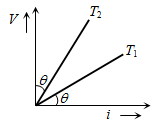
The V-i graph for a conductor at temperature   and   are as shown in the figure. ( is proportional to

(a) cos2θ

(b) sin θ

(c) cot 2θ 

(d) tan θ