MCQ
A vector is not changed if:
  • A
    It is rotated through an arbitrary angle.
  • B
    It is multiplied by an arbitrary scalar.
  • C
    It is cross multiplied by a unit vector.
  • It is slid parallel to itself.

Answer

Correct option: D.
It is slid parallel to itself.
A vector is defined by its magnitude and direction. If we slide it to a parallel position to itself, then none of the given parameters, which define the vector, will change.
Let the magnitude of a displacement vector $\big(\overrightarrow{\text{A}}\big)$ directed towards the north be 5 metres. If we slide it parallel to itself, then the direction and magnitude will not change.

Need a full question paper?

Generate a complete, print-ready paper with questions like this in minutes — across 16+ boards, with answer keys.

Start Generating Free

Similar questions

Assertion $(A):$ If there is not external torque on a body about its centre of mass, then the velocity of the centre of mass remains constant.

Reason $(R):$ The linear momentum of an isolated system remains constant.
A man runs at a speed of $4.0\ m/ s$ to overtake a standing bus. When he is 6.0m behind the door $(at t = 0),$ then bus moves forward and continues with a constant acceleration of $1.2\ m/ s^2$. The man shall access the door at time t equal to:
An optical bench has $1.5 m$ long scale having four equal divisions in each $cm$. While measuring the focal length of a convex lens, the lens is kept at $75 cm$ mark of the scale and the object pin is kept at $45 cm$ mark. The image of the object pin on the other side of the lens overlaps with image pin that is kept at $135 cm$ mark. In this experiment, the percentage error in the measurement of the focal length of the lens is. . . . .
Moment of inertia of a sphere of mass $M$ and radius $R$ is $I.$ Keeping $M$ constant if a graph is plotted between $I $ and $R,$ then its form would be
A particle of mass ${m}$ is suspended from a ceiling through a string of length $L$. The particle moves in a horizontal circle of radius $r$ such that ${r}=\frac{{L}}{\sqrt{2}}$. The speed of particle will be:
A block of mass ${m_1}$ rests on a horizontal table. A string tied to the block is passed on a frictionless pulley fixed at the end of the table and to the other end of string is hung another block of mass ${m_2}$. The acceleration of the system is
In the previous problem $(5.3),$ the magnitude of the momentum transferred during the hit is:
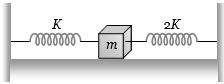
Two springs of force constants $K$ and $2K$ are connected to a mass as shown below. The frequency of oscillation of the mass is
The Poisson's ratio of a material is $0.5$. If a force is applied to a wire of this material, there is a decrease in the cross-sectional area by $4 \%$. The percentage increase in the length is ........ $\%$
A balloon with mass $m$ is descending down with an acceleration $a ($ where $a< g).$ How much mass should be removed from it so that it starts moving up with an acceleration $a\,?$