- It is rotated through an arbitrary angle.
- It is multiplied by an arbitrary scalar.
- It is cross multiplied by a unit vector.
- It is slid parallel to itself.
Explanation:
A vector is defined by its magnitude and direction. If we slide it to a parallel position to itself, then none of the given parameters, which define the vector, will change.
Let the magnitude of a displacement vector $\big(\overrightarrow{\text{A}}\big)$ directed towards the north be 5 metres. If we slide it parallel to itself, then the direction and magnitude will not change.
Generate a complete, print-ready paper with questions like this in minutes — across 16+ boards, with answer keys.
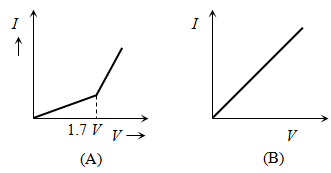
The V-i graphs A and B drawn for two voltameters. Identify each graph

|
(a) A for water voltameter and B for Cu voltameter |
|
(b) A for Cu voltameter and B for water voltameter |
|
(c) Both A and B represents Cu voltameter |
|
(d) None of these |
When the modulating frequency is doubled, the modulation index is halved and the modulating voltage remains constant, the modulation system is
|
(a) Amplitude modulation |
(b) Phase modulation |
|
(c) Frequency modulation |
(d) All of the above |
The galaxies are moving away from each other. It is explained by
|
(a) White dwarf star |
(b) Red shift |
(c) Neutron star |
(d) None of these |
An electron and a proton enter a magnetic field perpendicularly. Both have same kinetic energy. Which of the following is true
|
(a) Trajectory of electron is less curved |
(b) Trajectory of proton is less curved |
|
(c) Both trajectories are equally curved |
(d) Both move on straight-line path |
A slit of size 0.15 cm is placed at 2.1 m from a screen. On illuminated it by a light of wavelength 5 × 10⁻⁵ cm. The width of central maxima will be
|
(a) 70 mm |
(b) 0.14 mm |
(c) 1.4 mm |
(d) 0.14 cm |
$\text{P}=\lim_\limits{\triangle\text{s}\rightarrow0}\frac{\text{F}}{\triangle\text{s}}$ and $\text{P}_1-\text{P}_2-\text{pgz}$
In an elevator accelerating upward.
A coil having N turns is wound tightly in the form of a spiral with inner and outer radii a and b respectively. When a current I passes through the coil, the magnetic field at the centre is
|
(a) |
(b) |
(c) |
(d) |