MCQ
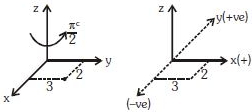
A vector $\vec a = 2\hat i + 3\hat j + 7\hat k$ is there in right handed rectangular coordinate system. The coordinate system is rotated about $z-$ axis from positive $x$ to positive $y-$ axis through angle $\pi /2$ , then new components of $\vec a$ will be
  • A
    $(2, 3, 7)$
  • B
    $(-2, -3, 7)$
  • C
    $(3, -2, -7)$
  • $(3, -2, 7)$

Answer

Correct option: D.
$(3, -2, 7)$
d
There will be no change in $z$ - component

$\therefore $ New component are $(3,-2,7).$

Need a full question paper?

Generate a complete, print-ready paper with questions like this in minutes — across 16+ boards, with answer keys.

Start Generating Free

Similar questions

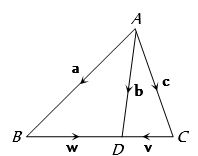
In the figure, a vector $x$  satisfies the equation $x - w = v$. Then $x =$
Let $f_1:(0, \infty) \rightarrow R$ and $f_2:(0, \infty) \rightarrow R$ be defined by

$f_1(x)=\int_0^x \prod_{j=1}^{21}( t - j )^{ j } dt , x >0$

and

$f_2(x)=98(x-1)^{50}-600(x-1)^{39}+2450, x>0,$

where, for any positive integer $n$ and real numbers $a _1, a _2, \ldots, a _{ n }, \prod_{i=1}^{ n } a _i$ denotes the product of $a _1, a _2, \ldots, a _{ n }$. Let $m _i$ and $n _i$, respectively, denote the number of points of local minima and the number of points of local maxima of function $f_i, i=1,2$, in the interval $(0, \infty)$

($2$) The value of $2 m_1+3 n_1+m_1 n_1$ is. . . . . .

($2$) The value of $6 m _2+4 n _2+8 m _2 n _2$ is. . . . . .

Give the answer or quetion ($1$) and ($2$)
Let $\lambda \in R , \vec{a}=\lambda \hat{i}+2 \hat{j}-3 \hat{k}, \vec{b}=\hat{i}-\lambda \hat{j}+2 \hat{k}$ If $((\vec{a}+\vec{b}) \times(\vec{a} \times \vec{b})) \times(\vec{a}-\vec{b})=8 \hat{i}-40 \hat{j}-24 \hat{k}$, then $|\lambda(\vec{a}+\vec{b}) \times(\vec{a}-\vec{b})|^2$ is equal to
Let $\text{f(x)}\begin{cases}\text{ax}^2+1,&\text{x}<1\\\text{x}+\frac{1}{2},&\text{x}\leq1\end{cases}.$ Then, $f(x)$ is derivable at $x = 1,$ if :
The area of the plane region bounded by the curves $x + 2{y^2} = 0$ and $x + 3{y^2} = 1$ is equal to
If $f(x) = 3x + 10$, $g(x) = {x^2} - 1$, then ${(fog)^{ - 1}}$ is equal to
Let $N$ denote the set of all natural numbers. Define two binary relations on $N$ as $R_1 = \{(x,y) \in  N \times  N : 2x + y= 10\}$ and $R_2 = \{(x,y) \in  N\times  N : x+ 2y= 10\} $. Then
${d \over {dx}}\left[ {{{\sin }^2}{{\cot }^{ - 1}}\left\{ {\sqrt {{{1 - x} \over {1 + x}}} } \right\}} \right]$ equals
$\left| {\,\begin{array}{*{20}{c}}1&5&\pi \\{{{\log }_e}e}&5&{\sqrt 5 }\\{{{\log }_{10}}10}&5&e\end{array}\,} \right| = $
Let x, y be two variables and x > 0, xy = 1, then minimum value of x + y is :