Question
A vector $\vec{A}$ points towards North and vector $\vec{B}$ points upwards then $\vec{A} \times \vec{B}$ points towards ...........

Answer

(a)

Here $z$-axis is vertically upward means normal to plane of paper as shown in figure.

Thus, $\overrightarrow{ A }= A \hat{ k }$ and $\overrightarrow{ B }= B \hat{ j }$

So, $\overrightarrow{ A } \times \overrightarrow{ B }= A \hat{ k } \times B \hat{ j }=- AB \hat{ i }$

Thus, it is along negative $x$-axis means along west.

Need a full question paper?

Generate a complete, print-ready paper with questions like this in minutes — across 16+ boards, with answer keys.
Start Generating Free

Similar questions

Let a total charge $2Q$ be distributed in a sphere of radius $R$, with the charge density given by $\rho(r) = kr$, where $r$ is the distance from the centre. Two charges $A$ and $B$, of $-Q$ each, are placed on diametrically opposite points, at equal distance, $a$, from the centre. If $A$ and $B$ do not experience any force, then
If the ratio of vapour density for hydrogen and oxygen is $\frac{1}{{16}}$, then under constant pressure the ratio of their rms velocities will be
The $SI$ unit of a physical quantity is pascal-second. The dimensional formula of this quantity will be ..............
A convex lens forming a real image of magnification $m_1$ on a screen is moved through  a  distance $x$. $A$ new image of magnification $m_2$ is again formed on the screen. The focal  length of the lens is:
Vibration magnetometer works on the principle of
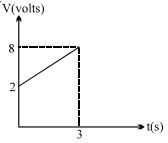
$A$ circuit element is placed in a closed box. At time $t=0$, constant current generator supplying a current of $1\, amp$, is connected across the box. Potential difference across the box varies according to graph shown in figure. The element in the box is :
Light is incident from a medium into air at two possible angles of incidence $(A)\, 20^o$ and $(B)\, 40^o$ . In the medium light travels $3.0\, cm$ in $0.2\, ns$. The ray will
When torque applied on a system is zero, which of the following will be constant?
body radiates energy $5W$ at a temperature of ${127^o}C$. If the temperature is increased to ${927^o}C$, then it radiates energy at the rate of ...... $W$
The hyper-metropia is a