MCQ
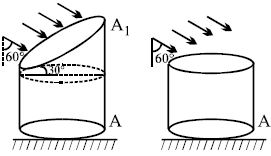
A vertical cylindrical container of base area $A$ and upper cross-section area $A_1$ making an angle $30^o $ with the horizontal is placed in an open rainy field as shown near another cylindrical container having same base area $A$. The ratio of rates of collection of water in the two containers will be
  • A
    $2/\sqrt 3$
  • B
    $4/\sqrt 3$
  • $2$
  • D
    None

Answer

Correct option: C.
$2$
c
In first container the Area vector is along the direction of rain. Rate of water collection in first container is $A_{1} \times$ velocity of rain.

In second cylinder the component of Area vector along the direction of rain is $A_{1} \cos 60^{\circ}=$$A_{1} / 2 .$ So, rate of water collection in second container is $0.5 A_{1} \times$ velocity of rain. The ratio of water collection is $2 .$

Need a full question paper?

Generate a complete, print-ready paper with questions like this in minutes — across 16+ boards, with answer keys.

Start Generating Free

Similar questions

In an orchestra, the musical sounds of different instruments are distinguished from one another by which of the following characteristics
A body cools from $60^{\circ} C$ to $40^{\circ} C$ in $6$ minutes. If, temperature of surroundings is $10^{\circ} C$. Then, after the next 6 minutes, its temperature will be $.........{ }^{\circ} C$.
The equation of a wave is $y = 2\sin \pi (0.5x - 200t)$, where $x$ and $y$ are expressed in $cm$ and $t$ in $sec.$ The wave velocity is  ...... $cm/sec$
A particle moves under the effect of a force $F = Cx$ from $x = 0$ to $x = {x_1}$. The work done in the process is
A particle of mass $1 kg$ is subjected to a force which depends on the position as $\vec{F}=-k(x \hat{i}+y \hat{j}) kgms ^{-2}$ with $k=1 kgs ^{-2}$. At time $t=0$, the particle's position $\vec{r}=\left(\frac{1}{\sqrt{2}} \hat{i}+\sqrt{2} \hat{j}\right) m$ and its velocity $\vec{v}=\left(-\sqrt{2} \hat{i}+\sqrt{2} \hat{j}+\frac{2}{\pi} \hat{k}\right) m s^{-1}$. Let $v_x$ and $v_y$ denote the $x$ and the $y$ components of the particle's velocity, respectively. Ignore gravity. When $z=0.5 m$, the value of $\left(x v_y-y v_x\right)$ is. . . . . $m^2 s^{-1}$
The apparent frequency of a sound wave as heard by an observer is $10\%$ more than the actual frequency. If the velocity of sound in air is $330\,m/sec$ , then

$(i)$ The source may be moving towards the observer with a velocity of $30\,ms^{-1}$

$(ii)$ The source may be moving towards the observer with a velocity of $33\,ms^{-1}$

$(iii)$ The observer may be moving towards the source with a velocity of $30\,ms^{-1}$

$(iv)$ The observer may be moving towards the source with a velocity of $33\,ms^{-1}$

A particle of mass $m$ is moving in a circular path of constant radius $I$ such that its centripetal acceleration $(a)$ is varying with time $t$ as $a=k^{2} rt^{2}$. where $k$ is a constant. The power delivered to the particle by the force acting on it is given as
Which of the following functions for $y$ can never represent a travelling wave?

$(a)$ $\left(x^2-v t\right)^2$

$(b)$ $\log \left[\frac{(x+v t)}{x_0}\right]$

$(c)$ $e^{\left\{-\frac{(x+v t)}{x_0}\right\}^2}$

$(d)$ $\frac{1}{x+v t}$

Tuning fork ${F_1}$ has a frequency of $256 Hz$ and it is observed to produce $6$ beats/second with another tuning fork ${F_2}$. When ${F_2}$ is loaded with wax, it still produces $6$ beats/second with ${F_1}$. The frequency of ${F_2}$ before loading was ..... $Hz$
A barometer kept in an elevator accelerating upward reads 76cm. The air pressure in the elevator is
  1. 76cm.
  2. < 76cm.
  3. > 76cm.
  4. zero.