MCQ
A vertical straight conductor carries a current vertically upwards. A point $P$ lies to the east of it at a small distance and another point $Q$ lies to the west at the same distance. The magnetic field at $P$ is
  • A
    Greater than at $Q$
  • Same as at $Q$
  • C
    Less than at $Q$
  • D
    Greater or less than at $Q$ depending upon the strength of the current
Answer

Correct option: B.
Same as at $Q$
b
(b) If distance is same field will be same

Need a full question paper?

Generate a complete, print-ready paper with questions like this in minutes — across 16+ boards, with answer keys.

Start Generating Free

Similar questions

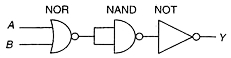
The circuit is equivalent to
Why the spring is made up of steel in comparison of copper
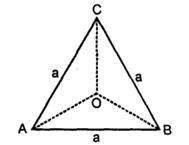
$ABC$ is an equilateral triangle. Length of each side is $a$ and centroid is point $O$. Find $\overrightarrow{A B}+\overrightarrow{B C}+\overrightarrow{C A}=.......$
Electric flux through a surface of area $100$ $m^2$ lying in the $xy$ plane is (in $V-m$) if $\vec E = \hat i + \sqrt 2 \hat j + \sqrt 3 \hat k$
A steel rod with ${y}=2.0 \times 10^{11} \,{Nm}^{-2}$ and $\alpha=10^{-5}{ }^{\circ} {C}^{-1}$ of length $4\, {m}$ and area of cross-section $10\, {cm}^{2}$ is heated from $0^{\circ} {C}$ to $400^{\circ} {C}$ without being allowed to extend. The tension produced in the rod is ${x} \times 10^{5} \, {N}$ where the value of ${x}$ is ....... .
Three identical thin rods each of mass $m$ and length $l$ are placed along $x, y$ and $z$ -axis respectively they are placed such that, one end of each rod is at origin $O$ . Then moment of inertia of this system about $z -$ axis is
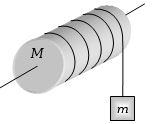
A mass $M$ is supported by a mass less string would wound a uniform cylinder of mass $M$ and radius $R$. On releasing the mass from rest, it will fall with acceleration
The internal resistance of a cell is the resistance of
Two trolleys of mass m and $3m$ are connected by a spring. They were compressed and released once, they move off in opposite direction and comes to rest after covering distances ${S_1}$and ${S_2}$ respectively. Assuming the coefficient of friction to be uniform, the ratio of distances ${S_1}:{S_2}$ is
Three equal charges $+q$ are placed at the three vertices of an equilateral triangle centred at the origin. They are held in equilibrium by a restoring force of magnitude $F(r)=k r$ directed towards the origin, where $k$ is a constant. What is the distance of the three charges from the origin?