MCQ
A vertical straight conductor carries a current vertically upwards. A point P lies to the east of it at a small distance and another point Q lies to the west in the same direction. The magnetic field at P is:
  • A
    reater or less than at Q, depending upon the strength of the current
  • B
    greater than at Q
  • C
    less than at Q
  • D
    same as at Q

Answer

(d) same as at Q
Explanation: As per Biot Savart Law, Magnetic field at a point is inversely proportional to square of distance from the current carrying conductor. Therefore magnitude of magnetic field is same at both points P and Q, irrespective of their position from the conductor.

Need a full question paper?

Generate a complete, print-ready paper with questions like this in minutes — across 16+ boards, with answer keys.

Start Generating Free

Similar questions

Consider the following statements regarding series grouping of capacitors and select the correct statements.
  1. Charge on each capacitor remains same and equals to the main charge supplied by the battery.
  2. Potential difference and energy distributes in the reverse ratio of capacitance.
  3. Effective capacitance is even less than the least of teh individual capacitances.
The phenomenon of light passing through the object is called:
The formula for induced e.m.f. in a coil due to change in magnetic flux through the coil is (here A = area of the coil, B = magnetic field)
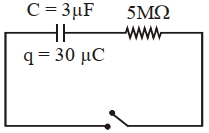
The circuit shown in the figure consists of a charged capacitor of capacity $3\, \mu F$ and a charge of $30\, \mu C$. At time $t =0,$ when the key is closed, the value of current flowing through the $5\, M \Omega$ resistor is $'x'$ $\mu-A$. The value of $'x'$ to the nearest integer is .........
$N-$ type semiconductors will be obtained, when germanium is doped with
In a compound microscope, if the objective produces an image $I_o$ and the eye piece produces an image $I_e$, then
A proton of velocity $\left( {3\hat i + 2\hat j} \right)\,ms^{-1}$ enters a magnetic field of  $(2\hat j + 3\hat k)\, tesla$. The acceleration produced in the proton is (charge to mass ratio of proton $= 0.96 \times10^8\,Ckg^{-1}$)
In vacuum an electron of energy $10 keV$ hits tungsten target, then emitted radiation will be
Which one of the following is the practical unit of power?
A parallel beam of light emerges from the opposite surface of the sphere when a point source of light lies at the surface of the sphere. The refractive index of the sphere is