Question
A vertical wire carrying a current in the upward direction is placed in horizontal magnetic field directed towards north. The wire will experience a force directed towards(a) North             (b) South(c) East   (d) West
       

Answer

(d) West

Need a full question paper?

Generate a complete, print-ready paper with questions like this in minutes — across 16+ boards, with answer keys.
Start Generating Free

Similar questions

A photon of energy hv is absorbed by o free electron of a metal having work function $\varphi<\text{hv}.$
A star emits light of 5500 Å wavelength. Its appears blue to an observer on the earth, it means(a) Star is going away from the earth(b) Star is stationary(c) Star is coming towards earth(d) None of the above
   
   
The plate current in a diode is zero. It is possible that:
  1. The plate voltage is zero.
  2. The plate voltage is slightly negative.
  3. The plate voltage is slightly positive.
  4. The temperature of the filament is low.
Electric charges are distributed in a small volume. The flux of the electric field through a spherical surface of radius $10\ cm$ surrounding the total charge is $25V-m.$ The flux over a concentric sphere of radius $20\ cm$ will be:
In the hysteresis cycle, the value of H needed to make the intensity of magnetisation zero is called(a) Retentivity(b) Coercive force(c) Lorentz force(d) None of the above
       
A charge $q$  is placed at the centre of the open end of cylindrical vessel. The flux of the electric field through the surface of the vessel is
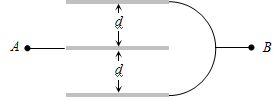
Three plates of common surface area $A$ are connected as shown. The effective capacitance will be

 
When the current i is flowing through a conductor, the drift velocity is v. If  2i  current is flowed through the same metal but having double the area of cross-section, then the drift velocity will be(a) v/4(b) v/2(c) v  (d) 4v
       
In Young's double slit experiment how many maximas can be obtained on a screen $($including the central maximum$)$ on both sides of the central fringe if $\lambda=2000 \mathring A$ and $d=700 \mathring A$
A thin lens is made with a material having refractive index $\mu=1.5.$ Both the sides are convex. It is dipped in water $(\mu=1.33).$ It will behave like: