MCQ
A vibrating string of certain length $\ell$ under a tension $\mathrm{T}$ resonates with a mode corresponding to the first overtone (third harmonic) of an air column of length $75 \mathrm{~cm}$ inside a tube closed at one end. The string also generates $4$ beats per second when excited along with a tuning fork of frequency $\mathrm{n}$. Now when the tension of the string is slightly increased the number of beats reduces $2$ per second. Assuming the velocity of sound in air to be $340 \mathrm{~m} / \mathrm{s}$, the frequency $\mathrm{n}$ of the tuning fork in $\mathrm{Hz}$ is
  • $344$
  • B
    $336$
  • C
    $117.3$
  • D
    $109.3$

Answer

Correct option: A.
$344$
a
$ \mathrm{n}_5=\frac{3}{4}\left(\frac{340}{0.75}\right)=\mathrm{n}-4 $

$ \therefore \mathrm{n}=344 \mathrm{~Hz}$

Need a full question paper?

Generate a complete, print-ready paper with questions like this in minutes — across 16+ boards, with answer keys.

Start Generating Free

Similar questions

An object of mass $M_1$ moving horizontally with speed $u$ collides elastically with another object of mass $M_2$ at rest. Select correct statement.
Equal masses $($meach$)$ are attached at the two ends of a string passing over two pulleys. Another mass is attached at the centre of the string. In order that there is no sag in the string, this mass should be:
A steel tape is calibrated at $20^{\circ} C$. On a cold day when the temperature is $-15^{\circ} C$, percentage error in the tape will be ........... $\%$ $\left[\alpha_{\text {steel }}=1.2 \times 10^{-5}{ }^{\circ} C ^{-1}\right]$
A policemen buzz a whistle of frequency $400\ Hz$. A car driver is approaching the policemen. The speed of car is $54\  kmh^{-1}$. The change in frequency experienced by the driver, when driver approaches the policemen and after he crosses the policemen, is ... $Hz$ [Velocity of sound is $350\  ms^{-1}$]
Two rods of different materials having coefficient of linear expansion $\alpha_1$and $\alpha_2$ and  Young's modulii $Y_1$ and $Y_2$ respectively are fixed between two rigid massive walls. The rods are heated such that they undergo the same increase in temperature. There is no bending of rods. If  $\alpha_1:\alpha_2= 2 : 3$, the thermal stress developed in two rods are equal provided $Y_1 : Y_2$ is equal to
Measure of two quantities along with the precision of respective measuring instrument is:$\text{A} = 2.5\text{ms}^{-1} \pm 0.5\text{ms}^{-1}$
$\text{B} = 0.10\text{s} \pm 0.01\text{s}$
The value of A B will be,
A solid cylinder and a solid sphere, having same mass $M$ and radius $R$, roll down the same inclined plane from top without slipping. They start from rest. The ratio of velocity of the solid cylinder to that of the solid sphere, with which they reach the ground, will be.
Mass of moon is $7.34 \times {10^{22}}\,kg$. If the acceleration due to gravity on the moon is $1.4\,m/{s^2}$, the radius of the moon is $(G = 6.667 \times {10^{ - 11}}\,N{m^2}/k{g^2})$
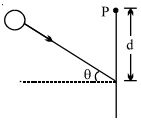
$A$ ball of mass $m$ moving with velocity $v$, collide with the wall elastically as shown in the figure.After impact the change in angular momentum about $P$ is:
A body of mass $5 \,kg$ is moving with velocity of $\vec{v}=(2 i+6 \hat{j}) \,m / s$ at $t=0 \,s$. After time $t =2 \,s$, velocity of body is $(10 \hat{i}+6 \hat{j})$, then change in momentum of body is ......... $kg m / s$