MCQ
A vibrating string of certain length $l$ under a tension $T$ reasonates with a mode corresponding to the first overtone (third harmonic) of an air column of length $75$ $cm$ inside a tube closed at one end. The string also generates $4$ beats per second when excited along with a tuning fork of frequency $n$. Now when the tension of the string is slightly increased the number of beats reduces to $2$ per second. Assuming the velocity of sound in air to be $340$ $m/s$, the frequency $n$ of the tuning fork in $Hz $ is
  • $344$
  • B
    $336$
  • C
    $117.3$
  • D
    $109.3$

Answer

Correct option: A.
$344$
a
$n = \frac{{3v}}{{4l}} = \frac{{3 \times 340}}{{4 \times \frac{{75}}{{100}}}} = 340{\mkern 1mu} {\rm{\,Hz}}$

Shring                Fork                Beats

$340$               $344$ or $336$             $4$

$T \uparrow $                                                $2$

Need a full question paper?

Generate a complete, print-ready paper with questions like this in minutes — across 16+ boards, with answer keys.

Start Generating Free

Similar questions

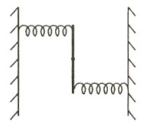
A uniform rod of length $L$ and mass $M$ is pivoted at the centre. Its two ends are attached to two springs of equal spring constants $k$. The springs are fixed to rigid supports as shown in the figure, and the rod is free to oscillate in the horizontal plane. The rod is gently pushed through a small angle $\theta$ in one direction and released. The frequency of oscillation is
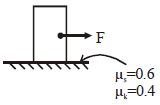
$10\, kg$ block is placed as shown, if $F = 50$ newton find friction force ............ $N$
A satellite in force-free space sweeps stationary interplanetary dust at a rate $\frac{d M}{d t}=\alpha v$ where $M$ is the mass, $v$ is the velocity of the satellite and $\alpha $ is a constant. What is the deacceleration of the satellite
Mass per unit area of a circular disc of radius $\mathrm{a}$ depends on the distance $\mathrm{r}$ from its centre as $\sigma(\mathrm{r})=\mathrm{A}+\mathrm{Br} .$ The moment of inertia of the disc about the the axis, perpendicular to the plane and passing through its centre is
$(\Delta\text{Q}-\Delta\text{W})$ is:
Bernoulli’s principle is based on the law of conservation of
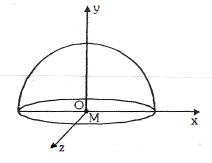
A hemisspherical shell of mass $2M$ and radius $6R$ and a point mass $M$ are performing circular motion due to their mutual gravitational interaetion Their positions are shown in figure at any moment of time during motion. If $r_1$ and $r_2$ are the radii of circular path of hemispherical shell and point mass respectively and ${\omega _1}$ and  ${\omega _2}$ are the angular speeds of hemi-spherical shell and point mass respectively, then choose the correct option
A particle $(A)$ moves due north at $3\,km / h$ another particle $(B)$ due west at $4\,km / h$. The relative velocity of $A$ with respect to $B$ is $\left(\tan 37^{\circ}=3 / 4\right)$
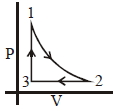
Which of the following is an equivalent cyclic process corresponding to the thermodynamic cyclic given in the figure? where, $1 \rightarrow 2$ is adiabatic.

(Graphs are schematic and are not to scale)

A body freely falling from the rest has a velocity $‘v’$ after it falls through a height $‘h’$. The distance it has to fall down for its velocity to become double, is