Question
A violin player riding on a slow train plays a 440Hz note. Another violin player standing near the track plays the same note. When the two are close by and the train approaches the person on the ground, he hears 4.0 beats per second. The speed of sound in air = 340m/s.
  1. Calculate the speed of the train.
  2. What beat frequency is heard by the player in the train?
Answer

Given,

Frequency of violins f= 440Hz

Speed of sound in air v = 340ms-1

Let the velocity of the train (sources) be vs.

  1. Beat heard by the standing man = 4

$\therefore\ \text{Frequency (f}_1)=440+4$

$\text{f}_1=444\text{Hz or 436 Hz}$

Now,

$\text{f}_1=\Big(\frac{340}{340-\text{v}_\text{s}}\Big)\times\text{f}_0$

On substituting the values,

We have,

$444=\Big(\frac{340+0}{340-\text{v}_\text{s}}\Big)\times440$

$\Rightarrow444(340-\text{v}_\text{s})=440\times340$

$\Rightarrow340\times(444-440)=440\times\text{v}_\text{s}$

$\Rightarrow340\times4=440\times\text{v}_\text{s}$

$\Rightarrow\text{v}_\text{s}=3.09\text{m/ s}=11\text{km/ h}$

  1. The sitting man will listen to fewer than 4 beats/-s. 

Need a full question paper?

Generate a complete, print-ready paper with questions like this in minutes — across 16+ boards, with answer keys.

Start Generating Free

Similar questions

A body falls towards earth in air. Will its total mechanical energy be conserved during the fall? Justify
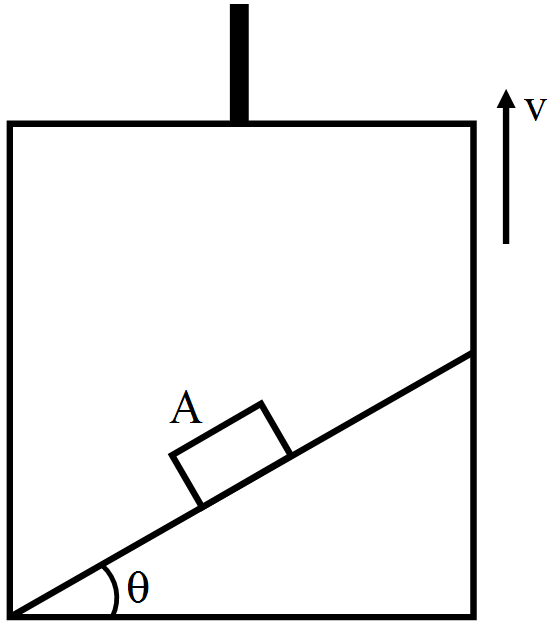
A block A can slide on a frictionless incline of angle $\theta$ and length l, kept inside an elevator going up with uniform velocity v. Find the time taken by the block to slide down the length of the incline if it is released from the top of the incline.

Find out the increase in moment of inertia I of a uniform rod $($coefficient of linear expansion $\alpha)$ about its perpendicular bisector when its temperature is slightly increased by $\Delta\text{T}.$
Find the centre of mass of a system of three particles at the vertices of an equilateral triangle. The masses of the particle are 100gm, 150gm and 200gm respectively. Each side of the equilateral triangle is 0.5m long.
Iron emits $\text{K}_\alpha$ X-ray of energy 6.4keV and calcium emits $\text{K}_\alpha$ X-rays of energy 3.69 keV. Calculate the times taken by an iron $\text{K}_\alpha$ photon to cross through a distance of 3km.
What will be the mean free path of nitrogen gas at STP of given diameter of nitrogen molecule $=2\mathring{\text{A}}?$
A 60kg man skating with a speed of 10m/s collides with a 40kg skater at rest and they cling to each other. Find the loss of kinetic energy during the collision.
A man runs across the roof-top of a tall building and jumps horizontally with the hope of landing on the roof of next building which is of lower height than the first. If his speed is 9m/ s, the (horizontal) distance between the two building is 10m and the height difference is 9m, will he able to land on the next building? Substantiate your answer.
Take g = 10m/ s2.
The temperature and the relative humidity are 300K and 20% in a room of volume 50m3. The floor is washed with water, 500g of water sticking on the floor. Assuming no communication with the surrounding, find the relative humidity when the floor dries. The changes in temperature and pressure may be neglected. Saturation vapour pressure at 300K = 3.3kPa.
Define impulse. A cricket ball of mass 150gm moving with speed of 12m/ s is hit by a bat so that the ball is turned back with a velocity of 20m/ s. Calculate the impulse received by the ball.