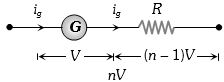
A voltmeter has a resistance of $G\, ohms$ and range $V\, volts$. The value of resistance used in series to convert it into a voltmeter of range $nV$ $volts$ is
Medium


Download our appand get started for free
Experience the future of education. Simply download our apps or reach out to us for more information. Let's shape the future of learning together!No signup needed.*
Similar Questions
- 1An electron is moving along positive $x$-axis. To get it moving on an anticlockwise circular path in $x-y$ plane, a magnetic filed is appliedView Solution
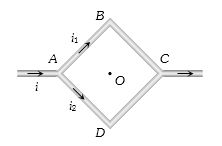
- 2Figure shows a square loop $ABCD$ with edge length $a$. The resistance of the wire $ABC$ is $r$ and that of $ADC$ is $2r$. The value of magnetic field at the centre of the loop assuming uniform wire isView Solution
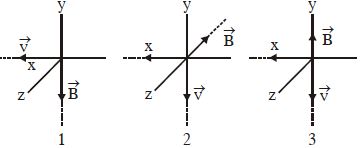
- 3The figure shows three situations when an electron moves with velocity $\vec v$ travels through a uniform magnetic field $\vec B$. In each case, what is the direction of magnetic force on the electronView Solution
- 4Two parallel wires in free space are $10\, cm$ apart and each carries a current of $10\, A$ in the same direction. The force one wire exerts on the other per metre of length isView Solution
- 5A steady eletric current is flowing through a cylindrical wireView Solution
$(a)$ the electric field at the axis of wire is zero
$(b)$ the magnetic field at the axis of wire is zero
$(c)$ the electric field in the vicinity of wire is Zero.
$(d)$ the magnetic field in the vicinity of wire is Zero - 6View SolutionMagnetic effect of current was discovered by
- 7View SolutionA metallic loop is placed in a magnetic field. If a current is passed through it, then
- 8For a moving coil galvanometer, the deflection in the coil is $0.05\,rad$ when a current of $10\,mA$ is passed through it. If the torsional constant of suspension wire is $4.0 \times 10^{-5}\,Nm\,rad ^{-1}$, the magnetic field is $0.01\,T$ and the number of turns in the coil is $200$,the area of each turn (in $cm ^2$ ) is :View Solution
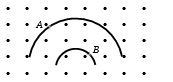
- 9Two particles $A$ and $B$ of masses ${m_A}$ and ${m_B}$ respectively and having the same charge are moving in a plane. A uniform magnetic field exists perpendicular to this plane. The speeds of the particles are ${v_A}$ and ${v_B}$ respectively, and the trajectories are as shown in the figure. ThenView Solution
- 10A proton (mass $ = 1.67 \times {10^{ - 27}}\,kg$ and charge $ = 1.6 \times {10^{ - 19}}\,C)$ enters perpendicular to a magnetic field of intensity $2$ $weber/{m^2}$ with a velocity $3.4 \times {10^7}\,m/\sec $. The acceleration of the proton should beView Solution